
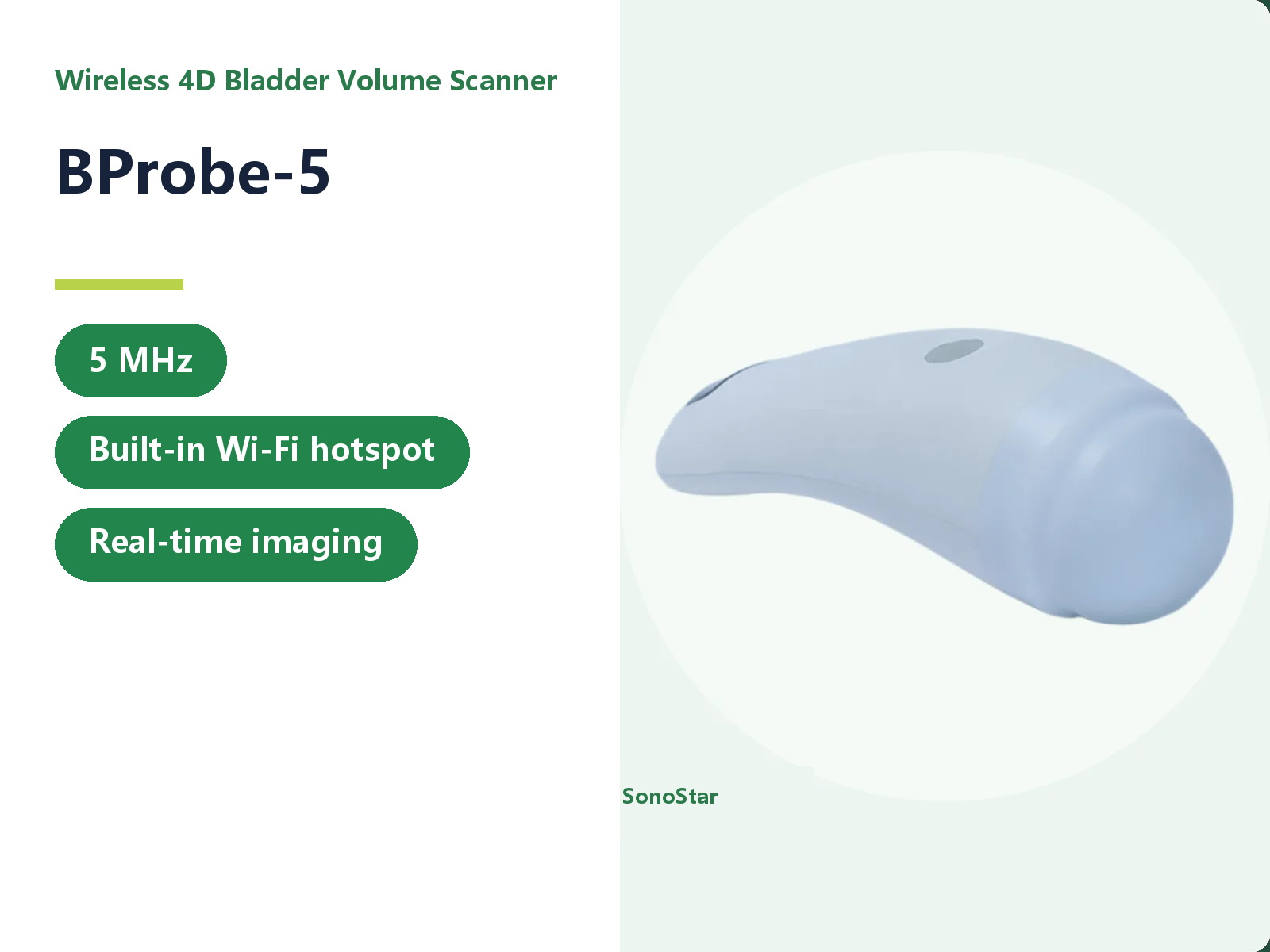
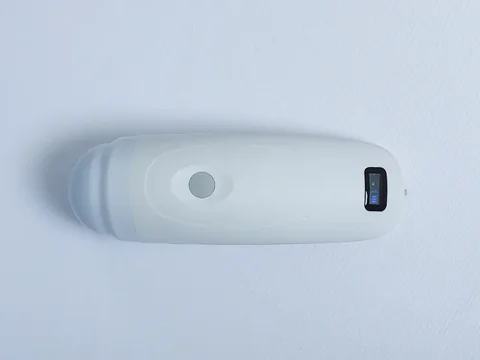
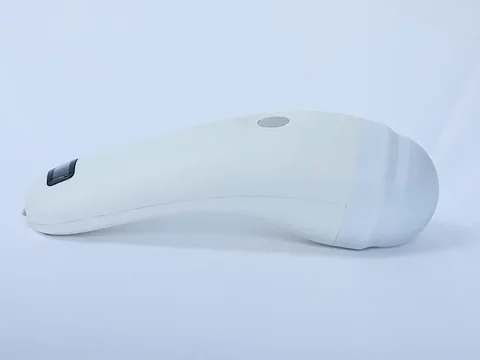
BProbe-5 Wireless 4D Bladder Volume Scanner
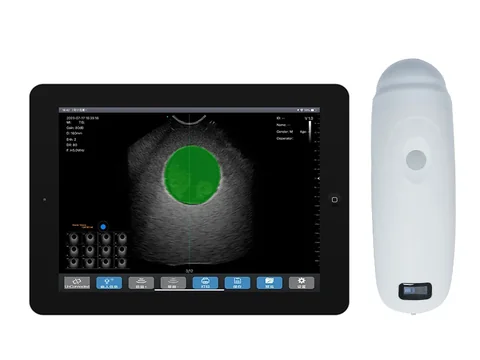
Single wireless probe streaming the image over WiFi. 4D scanning with the R20 probe keeps volume calculation consistent across a 50-2000 mL range.
- Brand: SonoStar
- Price: On request
- Probe frequency: 4D scanning probe, 5 MHz, wideband; supports Apple or Android tablets and phones; measurement range 50-2000 mL
- Connection: Wireless (built-in Wi-Fi image transmission)
- Charging: USB charging cable, about 2 hours to charge (see specifications)
- Category: Bladder Ultrasound
Product overview
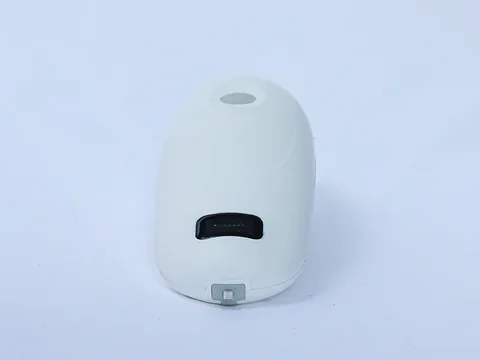
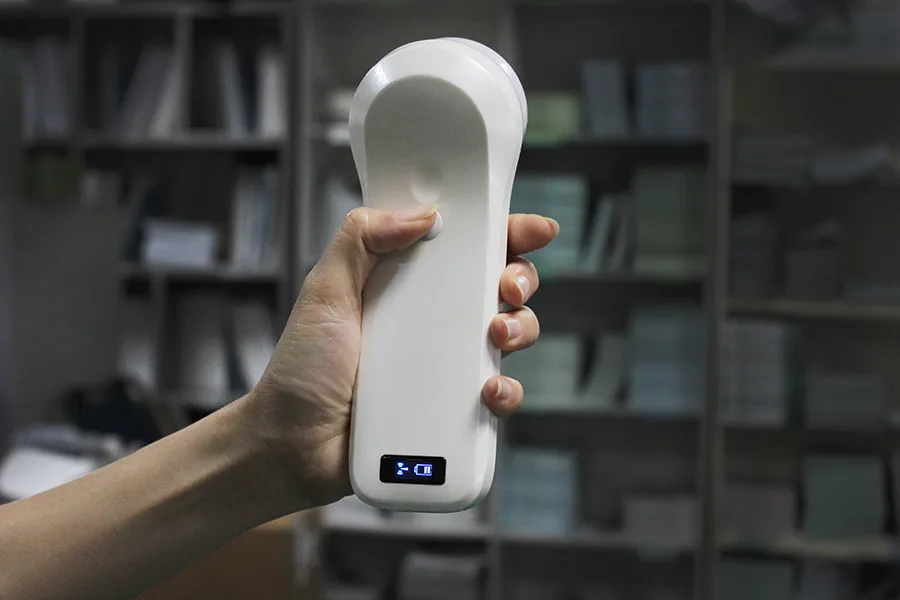
The BProbe-5 is a single handheld probe. It sends the image over Wi-Fi to a phone or tablet, so the set is easy to carry and quick to set up. The probe scans in 4D (four-dimensional), which keeps the image clear and the volume calculation consistent.
Intended use. The device is intended for measuring post-void residual bladder volume in patients with urinary incontinence, to support the decision on whether catheterisation is needed and how much urine should be drained, and to provide visual monitoring during catheterisation so that blind insertion and bladder injury can be avoided.
In urology it is used to grade acute and chronic urinary retention, which helps decide the timing of catheterisation and of surgery, to assess the effect of neuromodulation, and to grade urethral obstruction or prostatic enlargement.
Technical specifications
Specifications
The BProbe-5 is a single probe that sends the image over Wi-Fi to a phone or tablet, so it is easy to carry and easy to use. The probe scans in 4D (four-dimensional), which keeps the image clear and the volume calculation consistent.
Where it is used
- Urology - grading of acute and chronic urinary retention, to help decide the timing of catheterisation and of surgery; assessment of the effect of neuromodulation; grading of urethral obstruction or prostatic enlargement.
- Obstetrics - postpartum stress urinary incontinence; assessment of the degree of postpartum pelvic floor muscle damage.
- Gynaecology - assessment of pelvic floor nerve and muscle damage after pelvic tumour surgery, to help decide between surgery and rehabilitation.
- ICU - timing of intermittent catheterisation for patients on long-term catheter drainage, to reduce the number of insertions, lower the infection risk and support recovery of spontaneous voiding.
- Neurology - assessment of detrusor and sphincter damage in patients with neurogenic bladder.
- Nursing - timing of catheter removal after surgery, to shorten catheter dwell time and lower the infection risk.
- Rehabilitation - monitoring the effect of pelvic floor rehabilitation; planning bladder retraining programmes and providing a basis for assessing recovery of bladder function.
- Emergency - assessment of acute urinary retention and guidance for catheter insertion; assessment of suspected bladder injury or rupture after trauma.
- Radiotherapy - assessment of bladder function during radiotherapy in patients with pelvic or bladder tumours.
Product features
- One probe only - small, light and easy to carry.
- Wireless connection - free and easy to operate.
- High accuracy (error below 5%).
- Fast scanning and volume calculation (about 2 seconds).
- Measurement range of 50-2000 mL.
- Electronic convex 4D scanning with a high channel count and element count - clear image, no mechanical scanning distortion.
- R20 probe - a wide scan angle and a wide coverage area.
- High-resolution rotary encoder - precise positioning, no routine calibration service required.
- Refined volume algorithm, stronger bladder wall recognition and more accurate contour tracing, together with a higher-accuracy probe.
- The algorithm is less affected by bladder shape and size. Sex, age group and special situations such as hysterectomy do not need to be entered, and small or unusually shaped bladders are measured with better consistency.
- Good recognition of bladder walls with adherent air, so the volume can still be measured when the bladder is not full.
- Where a bladder wall is difficult to trace, the abnormal image can be added to the training set and used to improve the contour tracing.
- Real-time imaging during scanning, which supports visual monitoring while a catheter is inserted or removed.
Single-crystal 3D scanning vs array 4D scanning
| Item | Single-crystal 3D scanning | Array probe 4D scanning |
|---|---|---|
| Image clarity | Moderate | Clear |
| Scanning and calculation time | 4-8 seconds | 2 seconds |
| Measurement error | 15% | 5% |
| Image distortion | Mechanical scanning distortion | No mechanical scanning distortion |
| Periodic calibration | Required after long-term use | High-resolution rotary encoder, precise positioning, no recalibration service required |
Technical data
1. Probe and frequency: 4D scanning probe, 5 MHz, wideband.
2. Supported smart devices: Apple or Android tablet or phone.
3. Measurement range: 50-2000 mL.
4. Measurement error: below 5%.
5. Scanning time: under 2 seconds.
6. Volume calculation time: under 2 seconds.
7. Display frame rate of the scanned image: 15 frames per second.
8. Case storage: on the tablet.
9. Printing: through a Bluetooth printer.
10. Battery: built-in high-capacity battery for more than 2 hours of continuous operation; charged through a USB charging cable; charging time 2 hours.
11. Probe dimensions: 170 mm x 52 mm x 55 mm.
12. Weight: 200 g.
Standard configuration
Included: 4D wireless probe x1; USB charging cable x1; user manual x1.
Optional: smartphone or tablet; Bluetooth wireless printer; wireless charging pad or power bank; base for probe, printer and charging pad; trolley.
Specifications updated 2026-11-01
Typical applications
The application scenarios on this page describe the device based on its technical data and configuration. The actual scope of application is the one stated in the product registration certificate. Follow your institution's procedures and the instructions for use.
| Setting / department | Typical use | Configuration note |
|---|---|---|
| Urology | Post-void residual volume measurement; reference for catheterisation timing | Wireless probe, display on phone or tablet |
| Nursing | Reference for catheter removal timing after surgery | Quick measurement at the bedside |
| Rehabilitation / obstetrics and gynaecology | Pelvic floor and postpartum residual volume assessment | 4D scanning and volume calculation |
Usage and selection notes
The BProbe-5 belongs to the bladder volume measurement series.
The actual scope of application is the one stated in the product registration certificate. Please confirm the model and configuration with our product department.
For contraindications and precautions, refer to the instructions for use. The device must be operated by a licensed physician with the relevant qualifications.
The technical data on this page is taken from the product technical documentation; where it has been updated, the latest version applies. The listed departments and application scenarios describe the device based on its technical data, and the actual scope of application is the one stated in the product registration certificate. This page makes no claim about clinical outcome and does not constitute clinical guidance.
Related products
Need a quote or a sample for evaluation?
Tell us how you plan to use the system and our sales team will reply within one business day.
Get a quote