ECG and monitoring: this page is not about the image, only about whether it can be kept
The fifteen scenario pages before this one are all ultrasound: probe on the skin, image on the screen, physician reads the image. This page is different — ECG and monitoring equipment produces no image. An ECG machine gives a waveform, a fetal monitor gives three traces of fetal heart rate, contractions and fetal movement, a multi-parameter monitor gives a set of numbers plus a trend. So the selection question is not "is the image clear" but something else entirely: will what is measured at this moment still be retrievable, unchanged, at a follow-up in three days, a handover in a week, a review in a month.
Our ECG section holds 14 products: 7 ECG machines, 3 fetal monitors and 4 multi-parameter monitors. Every figure in the tables below is taken from their respective parameter tables.
The four constraints in this setting all sit outside the image
On the previous fifteen pages the constraint was "can it be seen"; here it is "can it be kept".
Ten-odd seconds of acquisition, judgement much later
A 12-lead ECG takes ten-odd seconds to acquire, and the person who really reads it may be a physician comparing it with the last one at a follow-up three days later. Ultrasound is read on the spot; ECG is acquired on the spot and read afterwards.
One examination leaves three things behind
Paper, data, and one line of conclusion. Paper curls at the edges, data can be exported, and the conclusion needs a signature. The question is how long each of the three is kept — not how many parameters it can measure.
Three device types answer three questions
An ECG machine answers "the heart's electrical activity this time", a fetal monitor "how the fetus is doing right now", a multi-parameter monitor "how the vital signs are changing continuously". The object of interpretation and the time scale both differ, so they cannot be forced into one comparison table.
Interfaces get overlooked before specifications do
"12-lead simultaneous acquisition" is the same on a dozen models; what separates them is the interface: the SE-12P connects to an ECG network management system and exports XML; the SM-100T offers VGA / LVDS / TTL outputs. If it will not connect to the hospital system, the specifications stay inside the machine.
All three are called monitoring, but they do not record the same thing
Settle this layer first; only then do the specifications mean anything.
| Device type | Question it answers | Form of the record |
|---|---|---|
| ECG machine (7 models) | The heart's electrical activity this time | 12-lead waveform; paper plus an exportable file |
| Fetal monitor (3 models) | How the fetus is doing in utero right now | Three curves: fetal heart rate, contractions, fetal movement |
| Multi-parameter monitor (4 models) | How the vital signs are changing continuously | Multi-parameter waveforms plus trends plus alarm events |
The third column is the one most often skipped. Ultrasound looks at structure, and the examination ends when acquisition ends; for these three categories acquisition is only the beginning, and the real output is a record you can go back to. Each section below carries one line on how it is kept.
Seven ECG machines: settle the platform first, then the number of channels
The platform decides where the report can go; the channel count decides what the paper looks like.
| Platform | Models on this site | Where the difference lies |
|---|---|---|
| Computer-based |
EBox-12
SE-12P |
Reports export as PDF / JPEG / XML; the database holds hundreds of thousands of records; connects to an ECG network management system |
| Embedded |
SE-12B
SE-3B SE-3C SE-3D SE-6B |
Works as soon as it is switched on, no computer needed; paper on the spot; three of them state 250 records on board, expandable |
The two computer-based models take different forms: the EBox-12 is an ECG box that works when connected to a computer running ECG software, with three shortcut keys — F1 acquire, F2 freeze, F3 print; the SE-12P is a 15-inch all-in-one, operable by touch or keyboard, exporting the same three formats and able to connect to a network management system. The five embedded models are strong on "no external device needed": power on, apply electrodes, press a key and paper comes out, with no computer to boot and no software licence — at the cost of reports that cannot leave the machine. So the real question at this tier is: do the reports need to circulate within the hospital?
| Model | Recording paper and channels | How it differs from the rest of its series |
|---|---|---|
| SE-3B | 80 or 50 mm, 3 channels | Sampling rate 8000 Hz; common-mode rejection > 100 dB; about 2.2 kg, the lightest in this group; per-lead indication of poor electrode contact |
| SE-3C | 80 mm, 3 channels | 7-inch screen at 480×680; manual / automatic / arrhythmia modes; 250 records on board |
| SE-3D | 80 mm, 3 channels | Every specification the same as the SE-3C; the only difference is a touch screen instead of keys |
| SE-6B | 112 mm, 6 channels | 6 channels on one screen, display 480×800; wider paper, so reading needs no page-turning |
| SE-12B | 216 mm, 12 channels | 12-channel simultaneous printing; built-in V1 / V3 / V5 screening modes; electrode-off alarm indicating the site |
One row deserves its own paragraph: compared item by item, the SE-3C and SE-3D are the same specification sheet, and the only difference is the touch screen. The 7-inch screen at 480×680, the three modes, 80 mm three-channel recording, 250-record storage, USB and RS232, AC or battery operation — all identical. Hesitating between these two comes down to operating habit alone. At the other end, the SE-12B is the only one in this group printing 12 channels simultaneously on 216 mm paper, and its parameter table says "suitable for large-scale screening" — the difference between a three-channel and a twelve-channel machine is not precision but how long one person has to spend.
Three fetal monitors: twin identification and maternal parameters, one on each
The most practical finding on this page: no single model makes both of them standard.
| Model | What it traces simultaneously | Twins and maternal parameters |
|---|---|---|
| SM-100 | Fetal heart rate plus fetal activity curve | Parameter table lists no twin or maternal parameters; optional NST automatic scoring |
| SM-110 | Fetal heart rate plus contractions plus fetal movement | Twins: offset display of fetal heart rate plus overlap detection alarm; SpO₂, pulse rate and blood pressure belong to the Plus version |
| SM-90 | Fetal heart rate plus contractions plus fetal movement | Maternal SpO₂ / pulse rate / non-invasive blood pressure as standard; twin display and fetal acoustic stimulation optional |
The trade-off is clear. For twins, go to the SM-110: its parameter table states a "fetal heart rate offset display mode, making it easier for staff to distinguish the two fetal heart rates visually", and a "fetal heart overlap detection and alarm system" — the latter addresses two heart-rate signals running into each other, the most practical nuisance in twin monitoring. To watch the mother as well, go to the SM-90: maternal SpO₂, pulse rate and non-invasive blood pressure are standard, with SpO₂ over 70%–99% and an accuracy of ±3%.
To have both, there are two routes: take the SM-110 up to the Plus version (the parameter table states that SpO₂, pulse rate and blood pressure are added, making six parameters), or add the twin option to the SM-90; prices and configuration details are not listed on this site and have to be asked for separately. One point is easy to get backwards: the SM-100 has the largest screen of the three (12.1-inch, tiltable), yet its parameter table has no contraction pressure, the monitoring content being fetal heart rate and the fetal activity curve — a large screen does not mean a full parameter set.
Four multi-parameter monitors: screen size maps to where it stands
This group is not selected by specification but by where it will be placed.
| Model | Screen and form | Where it fits |
|---|---|---|
| SM-500D | 15-inch 1024×768, up to 13 channels | Theatre: optional anaesthetic gas, depth of anaesthesia and end-tidal CO₂; resistant to defibrillation and electrosurgical interference |
| SM-500S | 12-inch 800×600, portable | Bedside and moving between beds in a ward: AC or battery, optional built-in recorder |
| SM-100T | 10-inch, brightness adjustable in 10 steps | Bedside positions that need the picture sent elsewhere: VGA / LVDS / TTL outputs for a large display |
| SM-500M | 7-inch portrait screen, front-facing lead sockets | Ambulance and transfer: saves lateral space and can be cabled against a wall; diagnostic / monitoring / surgical modes |
What they share is more telling than what separates them: all six parameters as standard; resistance to defibrillation and electrosurgical interference, SpO₂ monitoring at low perfusion, ST segment and arrhythmia analysis, dual over-pressure protection for non-invasive pressure, 720 hours of trends, 1000 blood pressure sets and 200 alarm sets — almost word for word the same across all four. Only three things really divide the tiers: screen size, depth of optional parameters, and waveform storage duration. The widest gap in optional parameters is on the SM-500D — beyond the six parameters it can add invasive blood pressure, end-tidal CO₂, depth of anaesthesia and anaesthetic gas, which is exactly why the screen is a 15-inch one and it supports up to 13 channels: a theatre needs far more curves on one screen than a ward does. The other three are narrower: the 500S offers invasive pressure and end-tidal CO₂, the 500M invasive pressure only, and the 100T invasive pressure plus a recorder.
What "can be kept" means: the storage specifications laid out
The table on this page most worth reading carefully — it decides what you can still retrieve three days later.
| Device | How much it holds on board | How it gets out |
|---|---|---|
| Computer-based ECG EBox-12 / SE-12P |
Hundreds of thousands of reports | Export as PDF / JPEG / XML; connects to an ECG network management system |
| Embedded ECG SE-3C / 3D / 6B |
250 records, SD card expandable to 1000 | USB, RS232 |
| Embedded ECG SE-3B / SE-12B |
Parameter table gives no specific capacity; the SE-12B supports SD card expansion | SE-12B can be fitted with a digital ECG workstation |
| Fetal monitoring SM-110 / SM-90 |
Up to 24 hours / more than 12 hours | Built-in thermal printer; TCP/IP networking, connects to a central station |
| Multi-parameter monitoring SM-500D |
720 hours of trends plus 12 hours of full-disclosure waveforms | 1000 blood pressure sets, 200 alarm sets, retained on power loss |
| Multi-parameter monitoring SM-500M / 500S / 100T |
720 hours of trends plus 2 hours of waveforms | 1000 blood pressure sets, 200 alarm sets |
Two figures in this table have to be read side by side: trends are kept for 720 hours, waveforms for only 2 hours. 720 hours is 30 days of numerical trends, so heart rate, blood pressure and SpO₂ changes can be reviewed over a month; but the actual ECG waveform from two hours ago can no longer be retrieved, only the numbers. For a ward bedside that is usually enough; for reviewing a particular arrhythmia episode, they are two entirely different capabilities.
One point has to be stated honestly here: the parameter table of the SM-500D says "2 hours of waveform storage and playback" under storage playback, and "12 hours of full-disclosure waveform storage and playback, waveform data retained on power loss" under storage — two waveform durations in the same sheet. This page treats it as "both statements stand, the basis needs confirming", and at purchase the manufacturer's written confirmation should govern.
Three set-ups, chosen by whose evidence the device keeps
The three tiers are not a ranking from worse to more expensive.
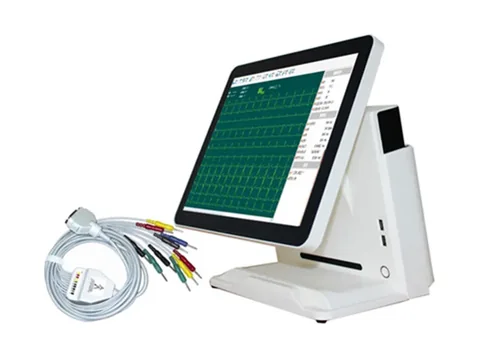
The one that issues the report · ECG machine
Where the examination point prints paper every day, reports go into the record, and follow-up means comparing with the last one. Representative model SE-12P: 15-inch all-in-one, operable by touch or keyboard, simultaneous 12-lead acquisition, export as PDF / JPEG / XML, database holding hundreds of thousands of records, connects to an ECG network management system; printing in 5 landscape and 5 portrait formats.
Trade-off: the advantage is entirely on the "things can get out" side, and both size and price are higher than an embedded unit.
See this model's specifications →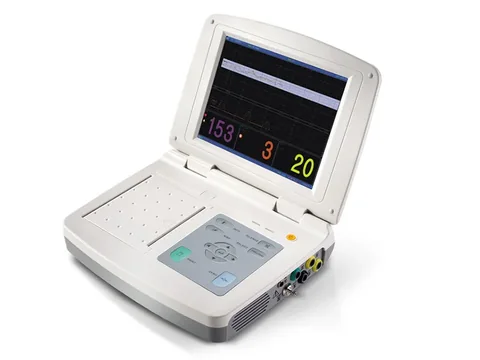
The three lines in the delivery room · fetal monitoring
Where labour requires fetal heart rate, contractions and fetal movement on one time axis, and both handover and review need the original curves back. Representative model SM-110: 10.1-inch screen tilting through 0–135°, twins distinguished by offset display plus overlap detection alarm, up to 24 hours of curve storage and playback, built-in thermal printer for real-time or retrospective printing, TCP/IP as standard for connection to a central station.
Trade-off: twin identification is its strength, but maternal parameters need the Plus version; if the maternal items are essential, switch to the SM-90.
See this model's specifications →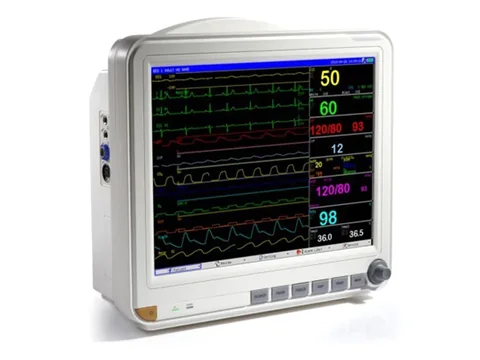
The screen that stays lit · multi-parameter monitoring
These devices stay on continuously, and their value is not in any single reading but in what happened over the past stretch of time. Representative model SM-500D: 15-inch 1024×768, up to 13 channels, six parameters as standard with optional invasive blood pressure, anaesthetic gas and depth of anaesthesia, 720 hours of trends, 200 alarm sets retained on power loss, wired and wireless mixed networking with nurse call.
Trade-off: a 15-inch unit takes up space at the bedside. With many transfer trolleys choose the 7-inch portrait SM-500M; to feed a large display choose the SM-100T with VGA.
See this model's specifications →Five things that are easily overlooked
- Run the 250-record figure against your caseload. 30 cases a day fills it in eight days; expanded to 1000 it lasts a month or so. What happens when it fills depends on whether there is a habit of regular export — something a parameter table never states, yet it decides whether you can still find last month's tracing in three months' time.
- Paper is a consumable, and the copy most easily lost. Thermal paper is stored as the instructions require, and for long-term archiving an electronic file should be kept as well. Reports from the two computer-based models export as PDF, so lost paper can be reprinted; the embedded units rely on manual export over USB and RS232, and that step has to be written into the departmental protocol.
- Trends and waveforms are not the same order of thing. 720 hours stores numbers, 2 hours stores curves. Numbers can say "the heart rate reached 130 at three o'clock"; only the waveform can say "and this is what kind of arrhythmia that was".
- A big screen does not mean a full parameter set. Among the fetal monitors the SM-100 has a 12.1-inch screen, larger than the other two, yet its parameter table has no contraction pressure; the SM-90 has only a 7-inch screen, yet makes maternal SpO₂, pulse rate and non-invasive blood pressure standard.
- When it says networking, ask who it connects to. All four monitors state "wired and wireless networking, mixed-network connection", all three fetal monitors can connect to a central station, and both computer-based ECG models can connect to a network management system. But "capable of networking" and "connected to the hospital system" are two different things: interface protocol, data format and who does the integration all have to be put in writing.
Four lines that cannot be crossed
This section matters more than every specification above.
- Automatic analysis has to be confirmed by a physician. Several ECG machines state automatic diagnosis or automatic analysis, the fetal monitors state graded audible and visual alarms, and the monitors state arrhythmia analysis with three-level audible and visual alarms. All of these are aids to judgement; their output becomes a diagnostic conclusion only after confirmation by a qualified physician or the appropriate staff member. We make no accuracy claim for automatic analysis results.
- Fetal monitoring does not cite absolute safety statements. The parameter table of the SM-90 on this site contains one sentence linking acoustic output to an absolute safety claim. Medical devices should not make statements of that kind; neither the body text nor the scenario pages on this site quote it, and it should not be used as a basis for purchase. The acoustic intensity of that model is stated factually: operating frequency 1.0 MHz, ultrasound intensity below 5 mW/cm², acoustic output limits as specified in IEC1157.
- An alarm is not a round. Three-level audible and visual alarms, adjustable limits and nurse call support exist to flag an abnormality; they do not change the division of responsibility for clinical rounds and interpretation. When electrode contact is poor or a probe falls off, the alarm may not sound — the SE-3B lists "per-lead indication of poor electrode contact" as a specification item precisely for this reason.
- Check the registration certificate's scope model by model. The parameter pages of these 14 products do not carry registration certificate numbers or the original intended-use wording. Every "place of use" on this page is based on technical specifications and configuration, is reference at the configuration level, and does not constitute a statement of intended use; the original certificate should be obtained and checked before purchase.
One more point: this page discusses the logic of device configuration. How a device is connected to the hospital system, how long data is kept and who may access it fall under the institution's information management and medical records policy, and are outside the scope of this page.
Common questions
Q: Is an ECG machine the same category of device as a cardiac monitor?
A: No. An ECG machine performs a single examination — simultaneous 12-lead acquisition, producing a waveform, paper and a report, and that is the end of it. A multi-parameter monitor provides continuous surveillance — ECG is only one of six items alongside heart rate, non-invasive pressure, SpO₂, respiration and temperature, and the output is a continuous trend plus alarms. One produces a report, the other a continuous record.
Q: How do I choose between a computer-based and an embedded ECG machine?
A: By whether the report needs to circulate in the hospital. If it has to go into the system, be reviewed across departments and archived in batches, choose computer-based (EBox-12, SE-12P), which export PDF / JPEG / XML and connect to a network management system; if paper is only handed to the patient at the examination point, choose embedded (from the SE-3B up), which works as soon as it is switched on and can be carried at 2.2–2.5 kg.
Q: Is 250 records on board enough?
A: It depends on caseload and export habits. 30 cases a day fills it in eight days; expanded to 1000 it lasts a month or so. Whether it is enough depends not on the number 250 but on whether someone exports regularly, and where to.
Q: Can twins and maternal SpO₂ and blood pressure both be had on one unit?
A: Among the three fetal monitors on this site, twin identification is most detailed on the SM-110 (offset display plus overlap detection alarm), and maternal parameters are standard on the SM-90. The two routes can be combined: the SM-110 with the Plus version, or the SM-90 with the twin option; configuration and price have to be confirmed separately.
Q: If trends are stored for 720 hours, does that mean I can look back a month?
A: The numerical trends, yes; the waveforms, not necessarily. 720 hours corresponds to trend data, and waveform storage is a separate line: the SM-500D states 12 hours of full-disclosure waveform (with 2 hours of playback stated elsewhere in the same table), and the SM-500M, SM-500S and SM-100T state 2 hours of waveform playback. To see the shape of a curve from a month ago you need networking and a central station.
Related reading
Choosing a cardiac monitor: ECG machines, fetal monitors, multi-parameter
All 14 devices mentioned on this page sit in that section, where specifications can be compared model by model.
See the product list →Emergency bedside: what the equipment must satisfy, and what has to be said first
The emergency department uses ultrasound and monitoring together; that page covers the time pressure of bedside decisions.
See the scenario →Obstetrics and gynaecology: ultrasound configuration from early pregnancy to labour
Fetal monitoring covers continuous observation in labour and ultrasound covers structure — the two complement each other.
See the scenario →Ultrasound guidance in anaesthesia: how to configure the equipment and choose the probe
In a theatre the monitor and the ultrasound are often in use at the same time; that page covers the ultrasound half.
Read →Settle how long each of the three things is kept, and the configuration follows
Tell us three things: roughly how many cases a day, whether the reports go into the hospital system, and whether you need to review numbers or waveforms. From those we can set the platform, the channel count, the storage and the networking; you can also download the selection table and compare for yourself first.
Download the selection table See other scenarios →The specifications described here are taken from the parameter tables published on this site; the places of use are reference information based on technical specifications and configuration, and the content stated in the product registration certificate prevails. For contraindications and precautions, refer to the instructions for use. The product must be operated by qualified medical staff, and automatic analysis results must be confirmed by a physician.