
Home and house-call ultrasound: what stops you is not the image, it is that nothing in that room is under your control
In an examination room the socket is on the wall, the bench is there already, the light and the temperature are set, and there is somewhere to clean the probe afterwards. Move to an elderly person's flat, to a care home, to a postnatal centre, and all four disappear: you hunt for a socket, there is no network, there is nowhere to put the screen, and the next household is already waiting while you finish this one. So what a house-call setting really has to choose is not "which unit gives a better image" but "which unit does not depend on the environment". Of everything in our line, the most direct sentence on this need is "the probe has a built-in WiFi signal and does not depend on whether the environment has WiFi" — that is not marketing language; it decides whether the scenario works at all.
Before you set out, confirm these four things are in your hands
The order of the four constraints matters: the first two decide whether you can switch on, the last two whether you can keep going.
There may be no socket at all
In older housing estates, older flats and temporary bed spaces, sockets tend to sit in a corner, hide behind furniture, or exist as a single one already taken by the television. A main unit needs mains power, and if the cable will not reach you move the equipment; a wireless probe is the whole system, the screen is a phone or tablet, both carry their own battery, and work starts whether or not anything can be plugged in.
Assume there is no network
This is the one most often got wrong. What a house call needs is not "is there WiFi here" but "does image transmission need the WiFi here". The parameter tables of several wireless probes on this site, including 6CPL and 9CPL, all read "the probe has a built-in WiFi signal and does not depend on whether the environment has WiFi" — the probe runs its own hotspot, the phone connects to the probe, and it has nothing to do with whether the flat has broadband.
Nowhere to put the screen
A main unit needs a bench top, needs the operator standing, needs the probe hung on the machine. In someone else's home all of this has to be renegotiated: can the table be used, does anything have to be moved, is a family member watching over your shoulder. A probe plus a phone or tablet takes up the space of a palm, and the value of that in a house-call setting is badly underestimated.
One household done, the next one waiting
A house call is not "one visit", it is "several households in a morning". Battery life, charging method and probe cleaning are what decide whether you can keep going. A model such as the 5CPL is specified at "about 3 hours (continuous scanning in normal working mode)"; the 6CPL at "2 hours"; the 9CPL at "replaceable battery, 2 supplied as standard, each good for 1.5 hours". Three different figures, so watch this when selecting.
The examinations usually done on a house call, and which probe each falls to
Frequencies and depths below are taken from our published parameter tables and can be checked item by item against the model.
| Examination | Probe type | Frequency · imaging depth |
|---|---|---|
| Abdominal organs, liver, gallbladder, spleen, kidneys | Convex | 3.2–5.0 MHz 90 / 160 / 220 / 305 mm |
| Residual urine, assessment before catheterisation | Convex | 3.2–5.0 MHz 160 / 220 mm settings |
| Postpartum pelvic floor, breast | Convex / linear | 3.2–5.0 MHz / 7.5–10.0 MHz switched by depth |
| Cardiac (simple views and effusion) | Phased array / cardiac mode | 3.2–5.0 MHz 90 / 120 / 140 / 160 mm |
| Thyroid, superficial lymph nodes | Linear | 7.5–10.0 MHz (10.0–12.0 MHz on some models) 20 / 40 / 60 / 80 mm |
| Subcutaneous tissue, pressure ulcers, subcutaneous oedema | High-frequency linear | 7.5–10.0 MHz 20 / 40 mm settings |
| Vessel location, puncture and infusion guidance | Linear with guide line | 7.5–10.0 MHz in-plane and out-of-plane modes |
One pattern runs through this table: the first five rows of a house-call service are covered completely by one convex and one linear probe; only rows six and seven need finer superficial capability. So the question is not "how many probes does a house call need" but "how much of your house-call work is superficial".
If superficial work is only ten or twenty per cent, a single-head convex probe is enough, and the rest of the budget is better spent on battery life and a spare battery — the 5C has depth settings of 90 / 160 / 220 / 305 mm, which covers abdomen and residual urine alike. If superficial work is more than half, a dual-head or three-in-one unit pays off, such as the 6CPL: convex 3.2–5.0 MHz and linear 7.5–10.0 MHz on the same probe, switched by button, and the convex head can also be switched in software to phased-array mode for cardiac views — one probe covering three.
Three set-ups, divided by who the house call is for
The three tiers correspond to three kinds of house-call service, not to a price ladder.
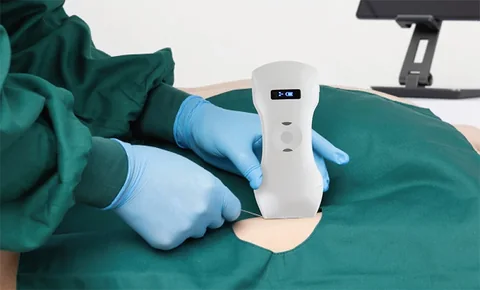
General practice house call · 6CPL, one probe, three heads
Contracted family-doctor services and chronic-disease follow-up, where a single visit has to run through abdomen, thyroid, vessels and simple cardiac views. Representative model 6CPL three-in-one wireless probe: convex/phased array 3.2–5.0 MHz, linear 7.5–10.0 MHz, convex depths 90 / 160 / 220 / 305 mm, linear 20 / 40 / 60 / 80 mm, all modes, with needle-tip echo enhancement.
Trade-off: heavier than a single-head probe (230 g), and the rated battery life is 2 hours, shorter than the roughly 3 hours of the 5 series. What you get in exchange is "one probe finishes all three kinds of examination", with no changing heads and reconnecting in someone's living room.
See this model's specifications →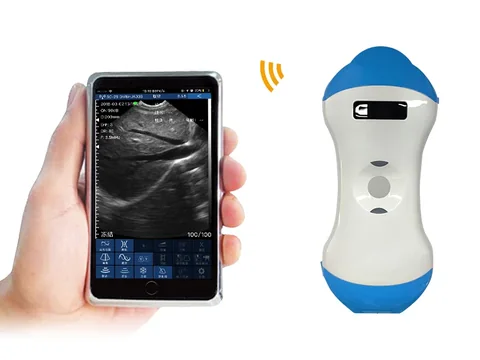
Small frames and postpartum · 5MN dual head
Where the patients are frail elderly people, postpartum women and children — thin abdominal walls and small contact surfaces, so a standard convex head presses down and lifts at both ends. Representative model 5MN micro-convex plus linear dual-head wireless probe: micro-convex 5.0–7.0 MHz with depths of 60 / 90 / 120 / 160 mm, linear 10.0–12.0 MHz with depths of 20 / 40 / 60 / 80 mm. Its application scenarios in our parameter table read verbatim: "care homes / postnatal centres: routine physical examination, residual urine assessment and catheterisation guidance, postpartum pelvic floor and breast examination".
Trade-off: the micro-convex contact surface is small and sits well on a small frame; the cost is a convex depth ceiling of 160 mm, not enough for a markedly obese abdomen. Those patients need the standard convex head instead.
See this model's specifications →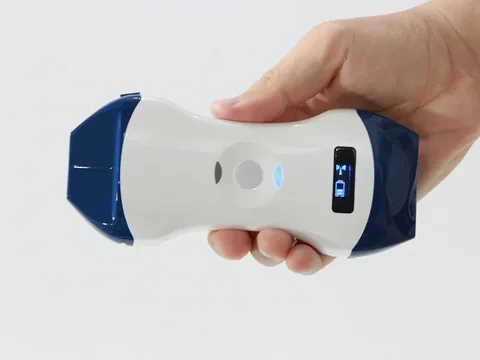
Superficial follow-up only · 5LP dual linear
Where the house call no longer looks at the abdomen but only at superficial structures — thyroid, breast, subcutaneous tissue, vessels — for example postoperative follow-up or monitoring of chronic-disease complications. Representative model 5LP linear plus high-frequency linear dual-head probe: depth adjustable over 20–100 mm, all modes, two linear heads, and its application scenarios in our parameter table read "family doctor / house-call services: routine physical examination and chronic-disease follow-up".
Trade-off: no convex head, so nothing abdominal can be done. Its value lies in the "one thing only" service model — a single programme, a fixed routine, consumables that are easy to carry.
See this model's specifications →There is also a more radical approach: if the house call is about the long term rather than a single visit, the question is no longer probe selection but the form of monitoring. The B1 wearable wireless urine-output monitor is that category: matchbox-sized, 45 g, about 26 hours of battery life, monitoring depth 300 mm, monitored volume 10–2000 ml, and its parameter table states "urine-output monitoring and alerting for the risk of incontinence and urinary retention, connectable to a workstation to receive alarms centrally".
The division of labour with a house-call probe is clear: a probe is "I come once today and look once"; a wearable is "I do not need to come, it is watching all the time". For care institutions, long-term care and patients back home after surgery, the former cannot solve the continuity problem.
Five things that are easily overlooked
- "3 hours" is a continuous-scanning figure, not "usable for three hours". The parameter table's wording is "continuous scanning in normal working mode". A real house call is intermittent, and connecting, standing by and switching on and off all draw power. To plan a half-day round, the safe approach is to carry a spare battery or a power bank — on replaceable-battery models such as the 9CPL the standard package is 2 batteries at 1.5 hours each, which in essence trades "battery life" for "replaceability".
- Battery life is not one number across models. Most of the 5 series is rated at about 3 hours, the 6CPL at 2 hours, some 7 series models at 1.5 hours (up to 3 hours with the extended battery), and the 9 series is two batteries at 1.5 hours each. When selecting, read the row for that specific model; never extrapolate from "this series is about three hours".
- Multi-screen mirroring depends on the device. Android devices can mirror over WiFi-Direct; Apple devices do not currently support it. Showing the image to a family member or teaching on site is directly affected by this difference — do not discover on arrival that it will not cast.
- The screen is lit by somebody else's light. Phones and tablets reflect badly in a bright living room or a south-facing bedroom, and when screen brightness is insufficient the image is barely readable. Blocking the light costs nothing yet affects the judgement on the spot far more than a few thousand more spent on a probe.
- Gel and tissues are counted per patient. A house call has no departmental consumables cupboard, so how many households you carry for and how much each uses is on you. Warming the gel matters especially in winter — cold gel on an elderly patient and cooperation drops immediately.
Four lines that cannot be crossed
This section matters more than every specification above.
- The licensing requirements for house-call services cannot be solved by equipment. Where an ultrasound examination may be performed, by whom, and what qualifications the institution needs fall under health administration. The device is only responsible for producing an image outside the hospital; it is not responsible for making the activity compliant. Clarify this before starting a house-call business — buying the equipment does not make it permissible.
- Probe cleaning and disinfection methods are not listed in our parameter tables. Of the parameter tables for 102 products, only a very small number of main-unit models state disinfection and ingress protection ratings explicitly; handheld probes currently list neither. With a house call touching different patients in succession, the cleaning routine must follow the instructions for use and the institution's protocols, not be applied from experience.
- "Portable" does not mean it can be put down anywhere. A probe is a precision device, and the acoustic window (scanning face) is the part most vulnerable to knocks and scratches. On a dual-head design such as the 5LP both heads sit at the two ends of the body, exactly the points most likely to be knocked when the probe is tossed into a bag. House-call kit needs a hard case, and that is usually not on the standard list.
- Check the registration certificate's scope model by model. Which regions and which patient groups a given probe is registered for is governed by what the certificate states. The patient mix in house-call work (very elderly, postoperative, postpartum, children) may differ from a routine outpatient clinic, so obtain the original certificate before purchase and check the "intended use" column — do not substitute the "applicable departments" line from a product page.
One more point: this page discusses the selection of ultrasound imaging equipment for home and house-call settings. House-call services also involve nursing procedures, specimen collection and medication management; those are outside the scope of this page and should not be mixed into the same comparison table as the ultrasound configuration.
Common questions
Q: There is no WiFi on a house call — can the probe still be used?
A: Yes. Two things have to be kept apart here: whether there is WiFi on site, and whether image transmission depends on the WiFi on site. The parameter tables of several wireless probes on this site read "the probe has a built-in WiFi signal and does not depend on whether the environment has WiFi" — the probe emits its own hotspot and the phone or tablet simply connects to the probe. Whether the flat has broadband or a router makes no difference to getting an image.
Q: Five households in one round — is the battery enough?
A: It depends on the model. Most of the 5 series is rated at about 3 hours, the 6CPL at 2 hours, some 7 series models at 1.5 hours, and the 9CPL has a replaceable battery (2 supplied, 1.5 hours each). Converted on a continuous-scanning basis, with each household taking a dozen minutes or so, most models are sufficient; but standby draws power too, so carry a spare battery or a power bank rather than planning the round right up to the battery limit.
Q: Can one device do both abdomen and thyroid?
A: Yes, with a dual-head or three-in-one design. The 6CPL is convex plus linear, switched by button; the 5CL and 5CP are convex-plus-linear dual-head designs. The difference is frequency: the linear head of the 5CP is 10.0–12.0 MHz, leaning towards superficial detail; that of the 5CL is 7.5–10.0 MHz, aimed slightly deeper. Which to choose depends on how superficial your superficial work has to be.
Q: The patient has a very thick abdominal wall — which probe?
A: Go back to the standard convex. Convex depth settings run 90 / 160 / 220 / 305 mm, abdominal examination in obese patients often needs more than 220 mm, and the 160 mm ceiling of a micro-convex will not be enough. The advantage of a micro-convex is sitting well on a small frame, not seeing deeper — those two point in opposite directions and one probe cannot be expected to do both.
Q: Can images from a house call be saved, and can a report be issued?
A: They can be saved. The parameter tables of models such as the 6CPL and 9CPL state that images can be stored as jpg, mp4 and DICOM, and that measurements include distance, area, circumference, heart rate and obstetric items. But "saved" and "a formal report" are two different things: report format, signature and archiving belong to the institution's information system and workflow, and the device only supplies the raw images and measured values.
Related reading
Primary-care screening: work back from a day's caseload
The constraints of house-call work and primary screening overlap heavily: nobody trained to operate, no fixed site, a mixed case mix.
See the scenario →Urology: separating residual urine measurement from structural imaging
Residual urine comes up again and again in house-call work, and that page sets out where measurement ends and reading an image begins.
See the scenario →Choosing between handheld, portable and cart-based ultrasound: start with where it will sit
Form factor comes before specifications, and the house call is the clearest illustration of that.
Read →Nursing and vascular access: from PICC puncture to removal assessment
The second thing most often taken on a house call is vascular access and infusion guidance.
See the scenario →Map out the round and the configuration surfaces by itself
Tell us three things: which patient groups you mostly visit, how long one visit takes, and how many households you cover in a day. From those three we can estimate the probe combination and the number of batteries you need; you can also download the selection cross-reference table and compare for yourself first.
Download the selection table See other scenarios →The specifications described here are taken from the parameter tables published on this site. Their scope is reference information based on technical specifications; the content stated in the product registration certificate prevails. For contraindications and precautions, refer to the instructions for use. The product must be operated by a licensed physician with the appropriate qualifications.