
Bladder Ultrasound
One probe is all it takes. The BProbe series connects wirelessly to a phone or tablet and uses 4D scanning to measure post-void residual urine — a reference for whether catheterisation is needed and how much to drain, and for managing bladder emptying.
Selection guide · how to choose by setting (click to expand)
Departments and settings
- Urology: assessing the severity of acute and chronic urinary retention, as a reference for catheterisation and the timing of surgery.
- Nursing: a reference for when to remove a catheter after surgery.
- Critical care: deciding when to perform intermittent catheterisation in patients with long-term catheters.
- Obstetrics, gynaecology, rehabilitation: assessment of post-void residual after childbirth and in pelvic floor care.
Device types and configurations
| Model | Probe frequency | Measurement range | Probe size / weight | Notes |
|---|---|---|---|---|
| BProbe-2 | 2.6 MHz | 10 ml to 2000 ml | 180 mm × 60 mm × 60 mm / 420 g | 4D scanning; scan and volume calculation each take under 1 second |
| BProbe-5 | 5 MHz | 50 ml to 2000 ml | 170 mm × 52 mm × 55 mm / 200 g | 4D scanning; R20 probe with a wide scan angle and coverage |
Key specifications
- Scanning method: electronic convex 4D scanning, without mechanical-scan distortion
- Measurement error: under 5%
- Display and storage: wireless connection to a phone or tablet, with cases stored on the device
- Printing: connection to a Bluetooth printer
- Battery: built-in battery for more than 2 hours of operation, USB or wireless charging, about 2 hours to full charge
Where it fits
- Urology and neurology: post-void residual assessment in urinary retention and neurogenic bladder.
- Critical care and nursing units: a reference for intermittent catheterisation and catheter removal in patients with indwelling catheters.
- Obstetrics, gynaecology and rehabilitation: assessment of voiding function after childbirth and in pelvic floor care.
- Emergency: a reference measurement of urine volume in acute urinary retention.
How it differs from our other ultrasound ranges
The device in this range takes the form of a single probe: it connects wirelessly to a phone or tablet, a clinician holds the probe to measure post-void residual on a per-examination basis, and it comes with dedicated bladder volume software. The wearable ultrasound systems we also supply measure urine volume as well, but by continuous monitoring after the device is attached. Compared with general-purpose units such as handheld ultrasound, this range uses dedicated bladder volume software to give a urine volume figure per examination. The three serve different purposes and are not interchangeable: choose by whether measurement is per examination or continuous, and whether dedicated urine volume measurement is required.
Common purchasing questions
Q: How does the probe display the image?
A: The probe connects over Wi-Fi to a phone or tablet, and once the software is installed it displays and calculates — no separate main unit is needed.
Q: How do I choose between the two models?
A: The BProbe-2 works at 2.6 MHz with a range of 10 ml to 2000 ml; the BProbe-5 works at 5 MHz with an R20 probe, a wider scan angle and coverage, and a smaller, lighter body. Please confirm the model with our product department.
Q: Can it tell whether catheterisation is needed?
A: The device measures post-void residual as a reference for catheterisation and bladder management; it does not constitute clinical advice.
The information on this page is a technical reference based on product specifications; the applicable scope is that stated in the product registration certificate. Contraindications and precautions are set out in the product manual, and the device must be operated by a licensed physician holding the relevant qualifications. Nothing on this page constitutes a claim of clinical efficacy.
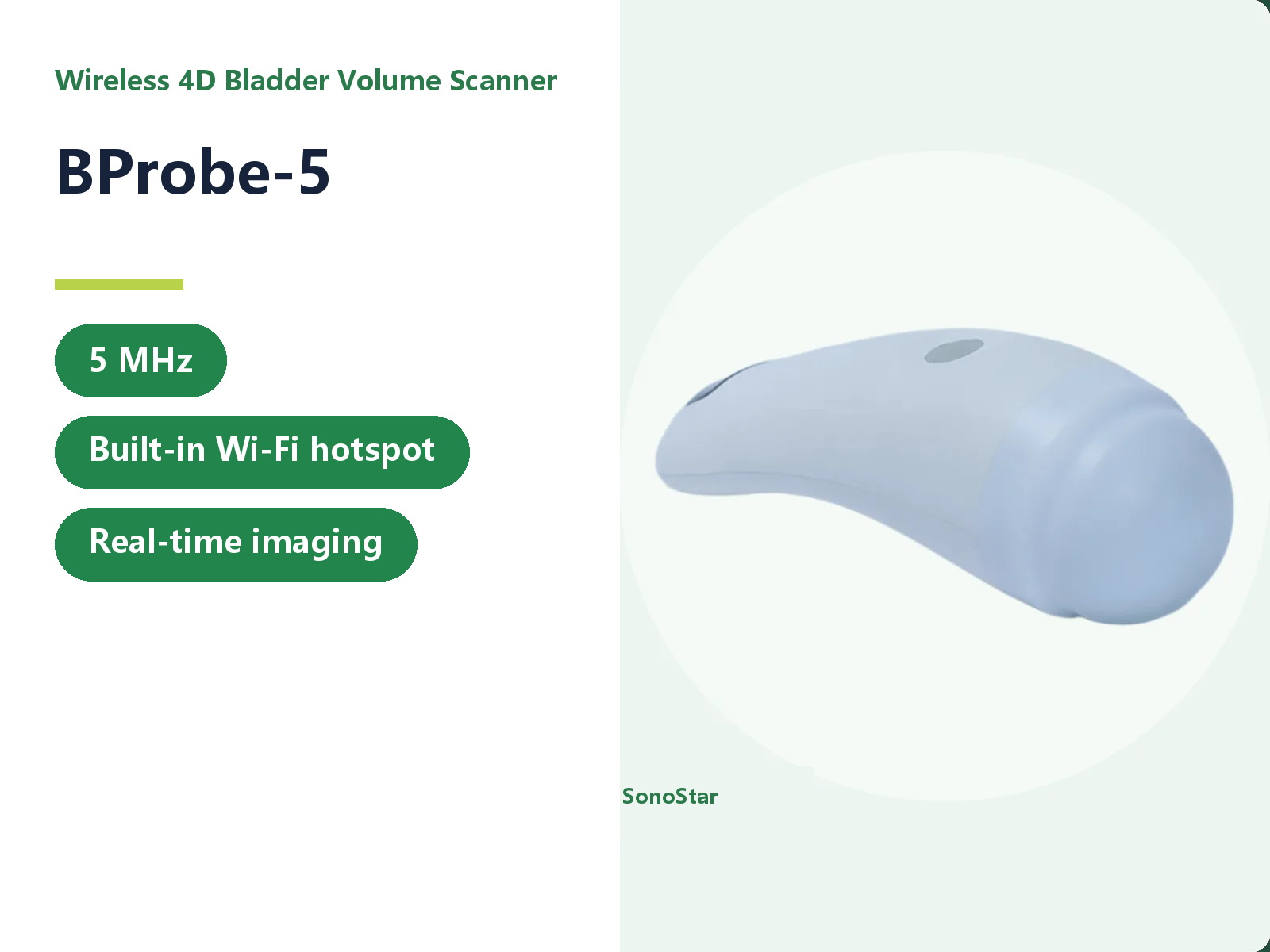
BProbe-5 Wireless 4D Bladder Volume Scanner
Wireless handheld probe for bladder volume measurement
View details →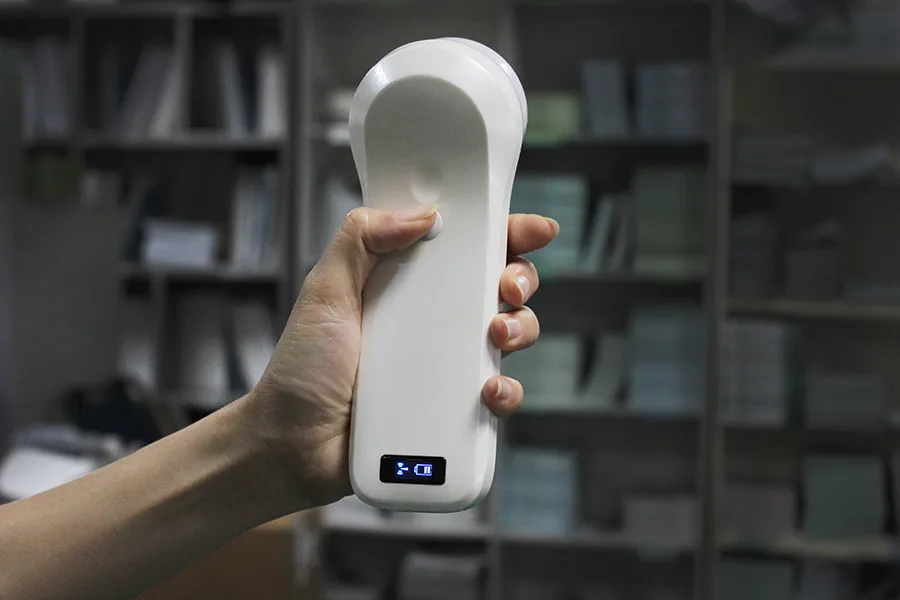
BProbe-2 Wireless 4D Bladder Volume Scanner
Wireless handheld probe for bladder volume measurement
View details →Frequently asked questions
Common questions about products and selection
What is a bladder scanner used for?
A clinician holds the probe and the image appears wirelessly on a phone or tablet; four-dimensional scanning measures residual urine volume, giving a reference point for catheterisation and voiding management.
How do I choose between the two models?
BProbe-2 operates at 2.6 MHz with a measurement range of 10 ml to 2000 ml; BProbe-5 operates at 5 MHz with an R20 probe, a wider scan angle and coverage, and a smaller, lighter probe. Confirm the choice with our product team.
How does it differ from the wearable range?
This range takes a measurement each time a clinician holds the probe to the patient; the wearable range is attached to the body and monitors bladder volume continuously. Choose by whether you need spot measurement or continuous monitoring.
Does it need a fixed main unit?
No. The probe connects to a phone or tablet over Wi-Fi; install the software to display and measure, store cases on the device, and connect a Bluetooth printer if needed.
Didn't find what you need?
Tell us how you will use the system, and we will propose an ultrasound configuration to match.
Contact us