Ophthalmic Ultrasound
The eye is only a few centimetres across, and seeing the vitreous, the retina and any lesion inside it takes a dedicated probe. The ophthalmic range puts A-scan and B-scan in one instrument — B-scan shows morphology, A-scan measures length and calculates intraocular lens power, so examination and pre-operative measurement are done on one machine.
Selection guide · how to choose by setting (click to expand)
Clinical departments
Ophthalmology outpatient clinics and wards, pre-operative assessment for cataract and refractive surgery, and ocular trauma in the emergency department.
Examinations supported
- B-scan: examination of the vitreous, retina and other intraocular structures, showing the position and shape of a lesion and its relation to surrounding tissue.
- A-scan and biometry: measurement of anterior chamber depth, lens thickness and axial length, and calculation of intraocular lens power.
- Corneal pachymetry (SPA-100): central and peripheral corneal thickness measurement.
Device types and configurations
| Model | Type | Imaging modes | Display | Notes |
|---|---|---|---|---|
| SAB-200 | Ophthalmic A/B scan | B, A | — | Runs from a computer with the software installed; compact and portable |
| SAB-500 | Ophthalmic A/B scan | B, B+B, B+A, A | 15-inch colour LCD | 10 MHz A-scan probe; built-in battery for 4 hours of operation |
| SAB-600 | Ophthalmic A/B scan | B, B+B, B+A, A | 15-inch colour LCD | Same configuration as the SAB-500 in a different housing |
| SPA-100 | Ophthalmic A-scan / pachymeter | A, P | Large colour LCD | 10 MHz A-scan plus 20 MHz P-scan; 6 IOL formulas |
Key specifications
- B-scan probe: 10 MHz (20 MHz optional), sector scanning, depth 60 mm, gain adjustable from 30 dB to 105 dB
- A-scan probe: 10 MHz, depth 40 mm; measurement range 15 mm to 40 mm, accuracy ±0.05 mm
- Corneal pachymetry (P-scan): 20 MHz probe, resolution 5 μm, measurement range 150 μm to 1500 μm
- B-scan image: 53-degree scan angle, 256 grey levels, axial resolution better than 0.3 mm and lateral resolution better than 0.2 mm
- IOL calculation: 6 formulas available (SRK-II, SRK-T, Binkhorst, Holladay, Hoffer-Q, Haigis)
- Measurement modes: phakic, aphakic and pseudophakic eyes; immersion and contact methods
Where it fits
- Ophthalmology outpatient clinics and wards: routine examination and follow-up of intraocular structures.
- Cataract and refractive surgery centres: pre-operative A-scan measurement and intraocular lens calculation.
- Cornea services: corneal thickness measurement.
How it differs from our other ultrasound ranges
This is the ophthalmic range, supplied with a dedicated ophthalmic probe and IOL calculation software; its applications and configuration differ from the abdominal, cardiac and other general ultrasound ranges. The two are not interchangeable, and selection follows the region to be examined.
Common purchasing questions
Q: Do I have to buy both A-scan and B-scan?
A: It depends on the work. For looking at intraocular structures alone, B-scan is enough; pre-operative measurement for cataract surgery and intraocular lens calculation need A-scan. The SAB series combines both in one instrument.
Q: How accurate is the A-scan measurement?
A: The reference material states a clinical measurement accuracy of ±0.1 mm and an electronic measurement accuracy of 0.0375 mm; the product registration certificate and technical documentation take precedence.
Q: How many probe configurations are there?
A: The A-scan probe can be used handheld, immersed, or mounted on a slit lamp; the B-scan is supplied at 10 MHz with 20 MHz optional.
The information on this page is a technical reference based on product specifications; the applicable scope is that stated in the product registration certificate. Contraindications and precautions are set out in the product manual, and the device must be operated by a licensed physician holding the relevant qualifications. Nothing on this page constitutes a claim of clinical efficacy.
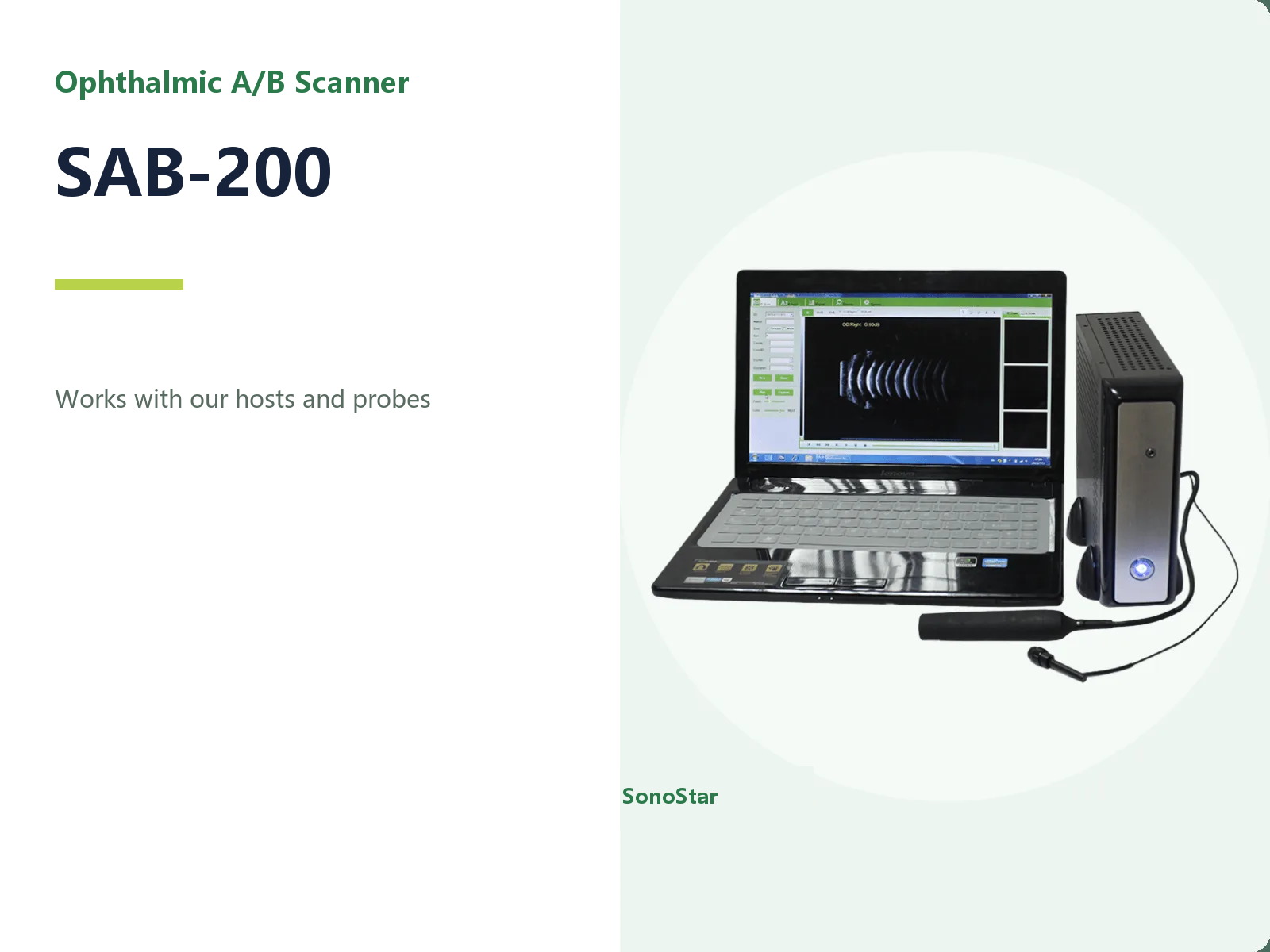
SAB-200 Ophthalmic A/B Scanner
PC-based ophthalmic ultrasound for B-scan imaging and A-scan biometry
View details →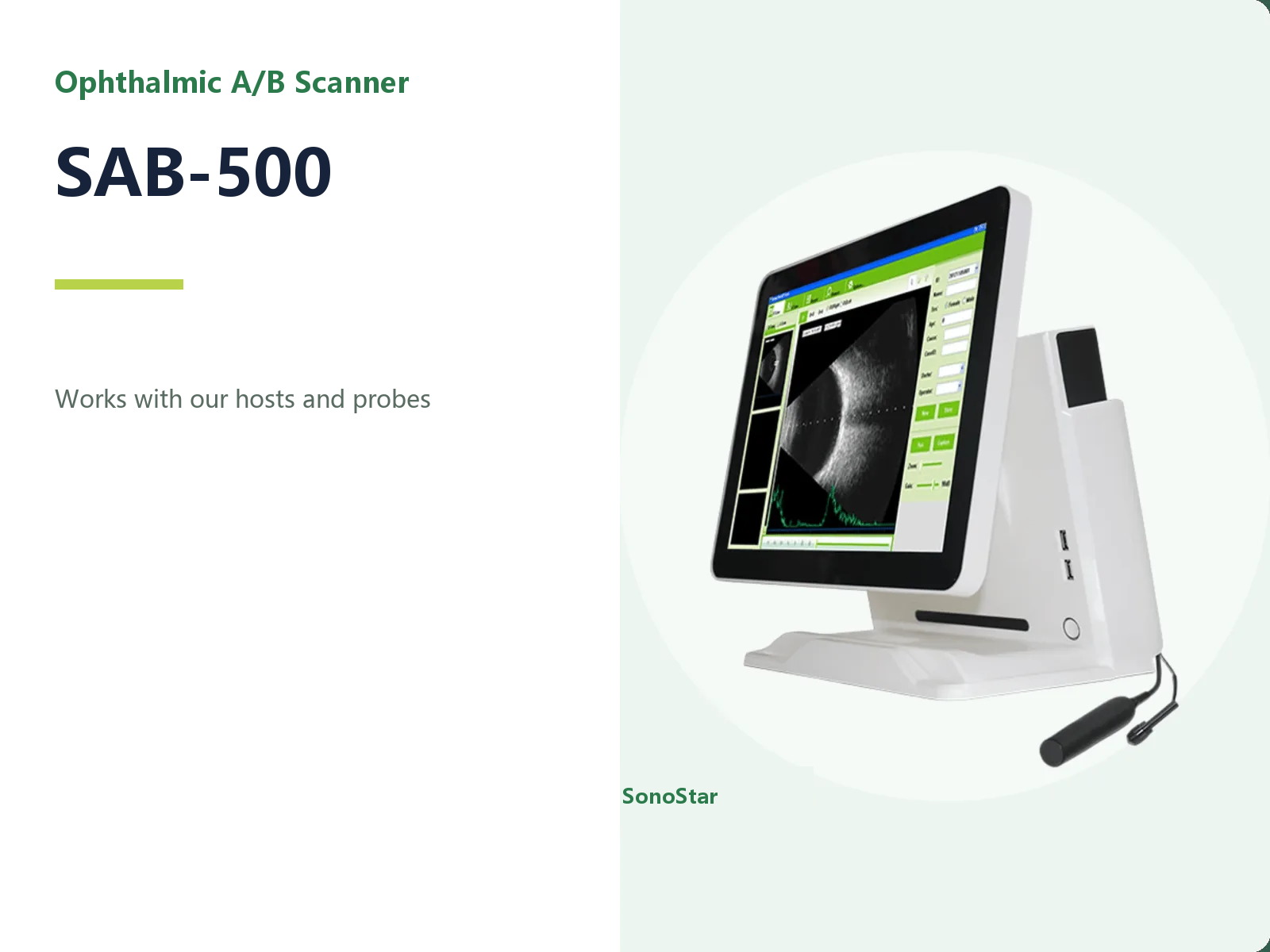
SAB-500 Ophthalmic A/B Scanner
Standalone ophthalmic A/B scanner with a 15-inch screen and built-in battery
View details →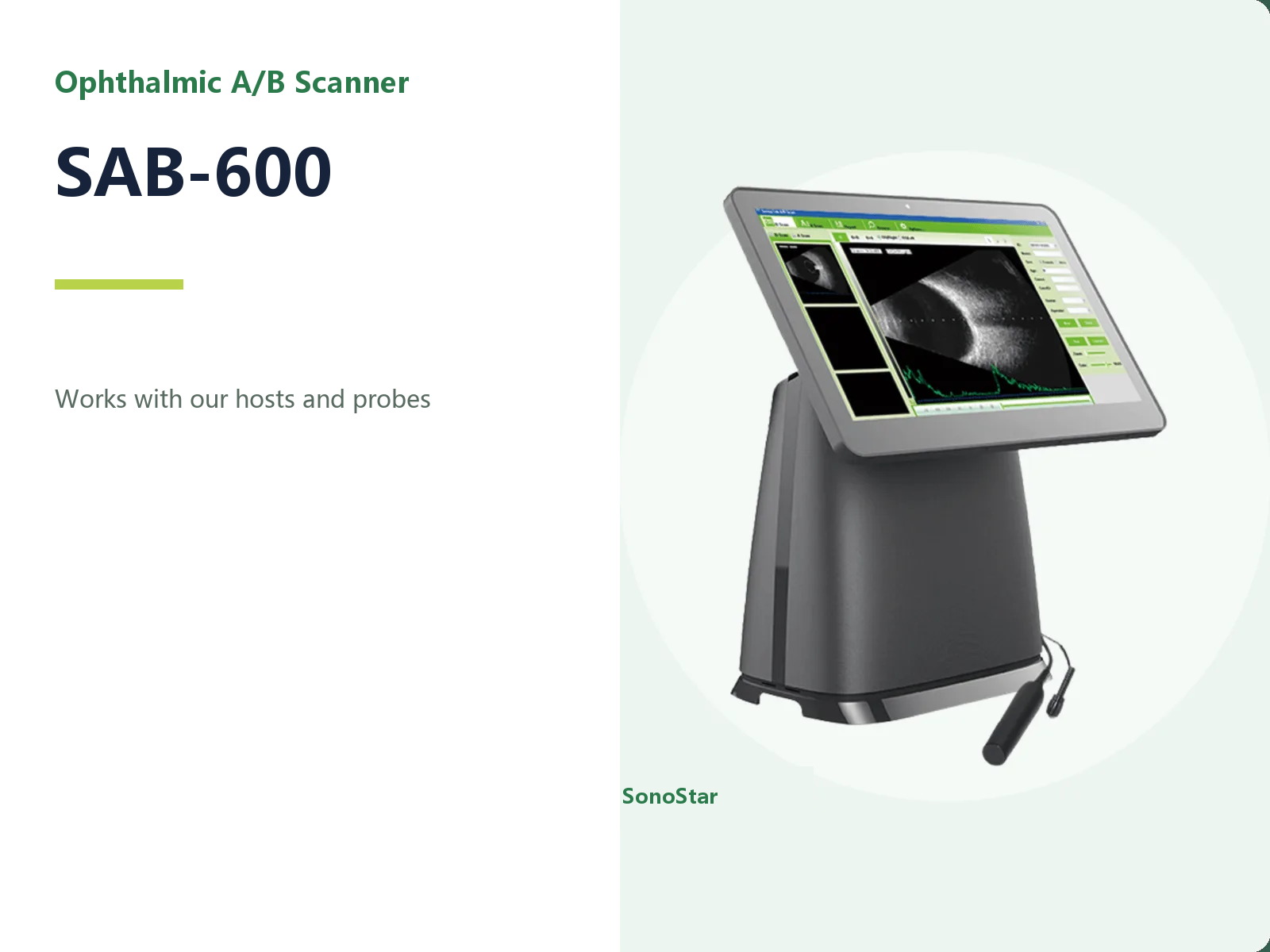
SAB-600 Ophthalmic A/B Scanner
Standalone ophthalmic A/B scanner with a 15-inch screen and custom report templates
View details →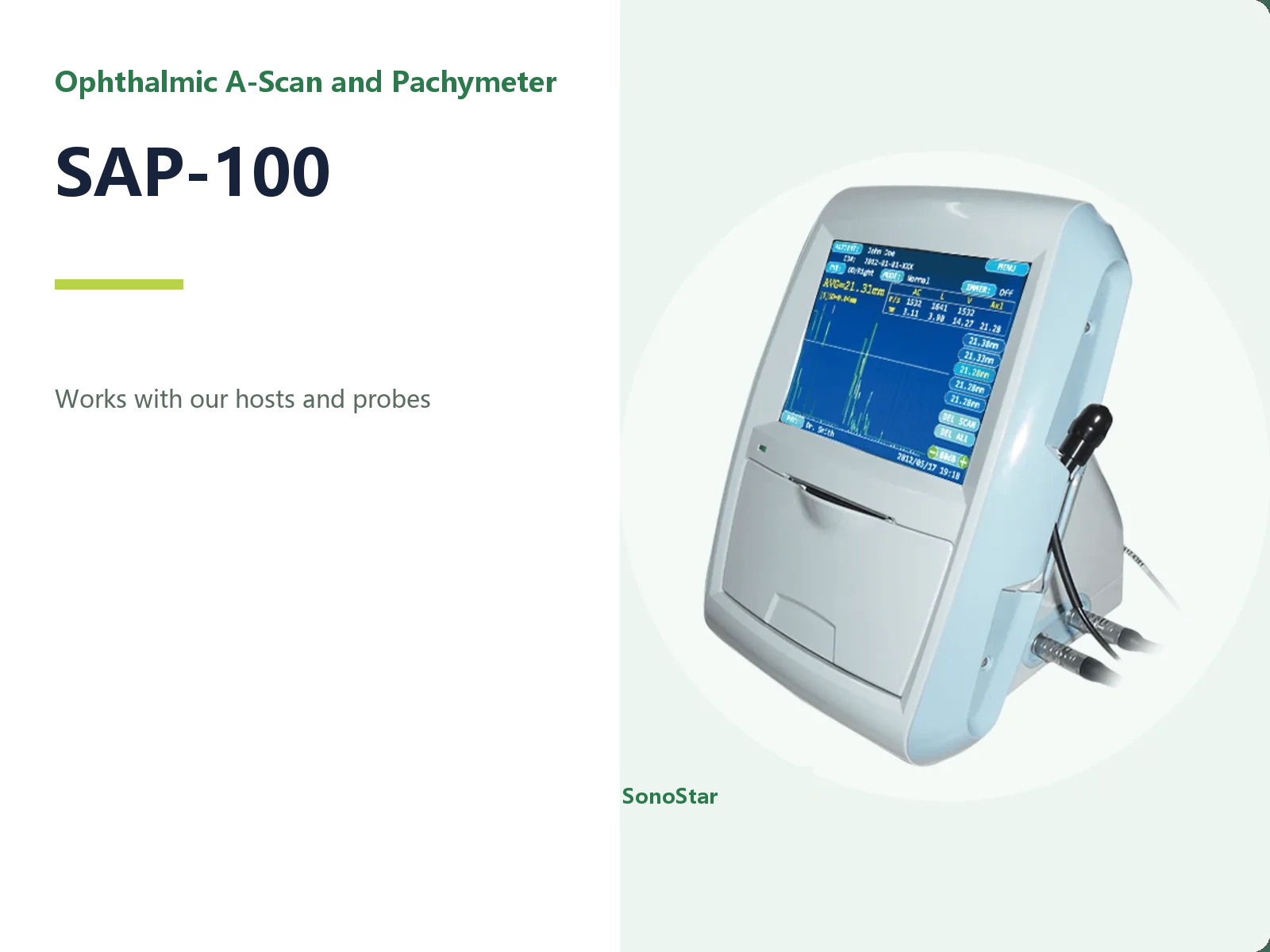
SAP-100 Ophthalmic A-Scan and Pachymeter
A-scan biometry plus corneal pachymetry in one unit
View details →Frequently asked questions
Common questions about products and selection
What do A-scan and B-scan do in ophthalmology?
B-scan examines intraocular structures such as the vitreous and retina and shows the position, shape and surrounding tissue of a lesion; A-scan measures anterior chamber depth, lens thickness and axial length, and is used for intraocular lens power calculation.
Which is needed for pre-cataract measurement?
A-scan with biometry. The SAB series combines A-scan and B-scan in one unit, covering both intraocular examination and pre-operative measurement; the SPA-100 A-scan and pachymeter is available separately.
What probe configurations are available?
B-scan comes with a 10 MHz probe as standard, with 20 MHz optional; the A-scan probe is 10 MHz and can be hand-held, immersion or slit-lamp mounted; corneal pachymetry uses a 20 MHz probe.
How is the intraocular lens power calculated?
Six IOL formulas are built in: SRK-II, SRK-T, Binkhorst, Holladay, Hoffer-Q and Haigis, with measurement modes for phakic, aphakic and pseudophakic eyes. The applicable formula depends on the model and its technical documentation.
Didn't find what you need?
Tell us how you will use the system, and we will propose an ultrasound configuration to match.
Contact us