
Veterinary ultrasound: ask what animal and by which route before asking about specifications
The key difference between veterinary and human ultrasound is simple: people do not struggle, animals do. So the first variable is not frequency and not depth, but what the animal is, how big it is, and where the probe goes in. Pregnancy checks in cattle and horses go per rectum; pig backfat is measured from the skin surface; sheep need a small probe; cats and dogs mean abdomen and heart. Those four needs correspond to four quite different probes, and if the direction is wrong, higher specifications will not help.
Four constraints to work through first
The order matters: settle the animal and the route, then the probe, and only then the configuration.
The animal does not cooperate
Examinations are short and the animal moves. The device has to be holdable in one hand, the probe able to sit on the animal's skin or enter the rectum, and the screen square in front of the operator — this decides whether an examination can be done at all, more than resolution does.
The environment is wet and dirty
Barns and farms get hosed down and are dusty. Water and dust protection on the unit is not a bonus feature; it is the precondition for using it long term. Probe cables get washed too.
No power and no network is normal
Pastures have few sockets and no usable WiFi. The device has to last a working day on its own battery, and the image has to travel by the probe's own WiFi to a phone or tablet without depending on the farm's network.
What is wanted is a few specific numbers
Gestational age, backfat thickness, loin eye area — the value of a veterinary examination often lies not in a handsome image but in a few numbers that can go into the record and be compared across animals.
Which probe for each animal and each task
The frequencies and depths below come from the specification tables for the veterinary products on this site and can be checked item by item against the product pages.
| Animal and task | Probe | Frequency · penetration depth |
|---|---|---|
| Cattle, horses: advanced pregnancy (transrectal) | VProbe-C transrectal convex | 3.5–5.0 MHz 90 / 160 / 220 / 305 mm |
| Cattle, horses: early pregnancy (transrectal) | VProbe-L transrectal large linear | 7.5–10.0 MHz 20 / 40 / 60 / 100 mm |
| Sheep (small frame) | VProbe-N small probe | Confirm against the actual configuration |
| Pigs: backfat and loin eye area | VProbe-2B backfat probe | 5 MHz 40–120 mm |
| Companion animals: abdomen and heart | VProbe-5Q microconvex handheld | 6.5–8.0 MHz 40–100 mm |
| Companion animals: superficial work and puncture guidance | VProbe-4L linear | 7.5–10.0 MHz 20 / 30 / 40 / 55 mm |
| Single-probe rapid pregnancy check (entry level) | VProbe-1 sector probe | 3.5 MHz 100–180 mm |
| Large-animal rectal examination (complete unit) | V6 with rectal probe | Maximum penetration depth 270 mm, probe cable 2.5 m |
The first two rows are the easiest to misread. Both are transrectal work in cattle and horses, but a linear probe suited to early pregnancy cannot see a late one — 7.5–10.0 MHz reaches only 20–100 mm, which suits close-range resolution early on; once pregnancy is advanced the uterus has moved away from the rectal wall, and a convex probe at 3.5–5.0 MHz is needed to reach 305 mm. So veterinary probes are less often a single general-purpose choice than a set used according to stage of pregnancy.
The sheep probe in the third row is listed here as VProbe-N in the small size; exact figures should be confirmed against the actual configuration. Sheep of different frame need different depths, and asking the product team at the purchasing stage is more reliable than guessing from a model name.
The fifth and sixth rows are the companion-animal side. The VProbe-5Q microconvex handheld (6.5–8.0 MHz, depth 40–100 mm) covers a lot of ground — abdomen and heart both — and adds in-plane and out-of-plane puncture guidance with needle-tip enhancement; the VProbe-4L linear (7.5–10.0 MHz, depth 20–55 mm) suits superficial structures and puncture better, at 11 cm × 6 cm × 2 cm and 120 g.
Three common configurations, chosen by the shape of the business
From a single probe for pregnancy checks to a complete unit with a full set of probes — three different operating situations.
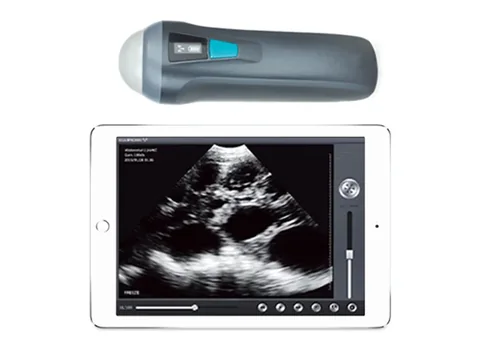
Pregnancy checks only · Starting with one probe
For breeding stations, solo practitioners and on-farm pregnancy checks. Representative model: the VProbe-1 sector wireless ultrasound probe — 3.5 MHz, scanning depth 100–180 mm, 80° sector scan, B mode, 256 grey levels, 8 pseudo-colour maps, 3 hours of battery, 140 mm × 45 mm × 40 mm.
Its positioning is clear: one probe, wireless, displayed on a phone or tablet, ready for pregnancy checks as soon as it is switched on. The cost is no colour flow or Doppler, depth limited to 180 mm, and no answer for complicated cases.
See the specifications →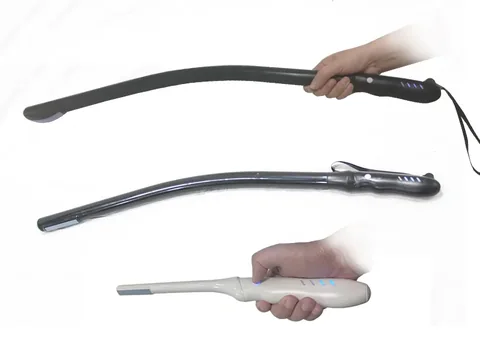
A set changed by stage · One combination
For large cattle and horse operations and mixed farms. Representative models: the VProbe veterinary wireless probes, three in the same series — VProbe-C transrectal convex (3.5–5.0 MHz, depth 90 / 160 / 220 / 305 mm) for advanced pregnancy in cattle and horses; VProbe-L transrectal large linear (7.5–10.0 MHz, depth 20 / 40 / 60 / 100 mm) for early pregnancy; VProbe-N in the small size for sheep.
Convex face radius R60, linear width L64, 6–8 hours of battery, USB charging. Changing probe by stage of pregnancy is the most practical approach in this setting.
See the specifications →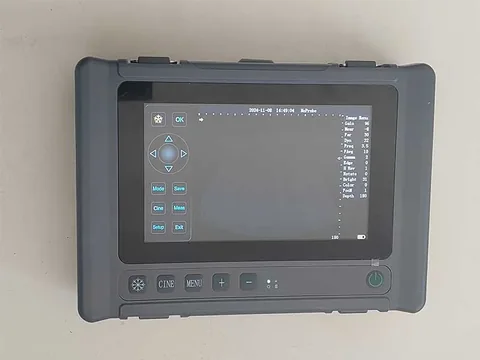
A complete unit · With measurement packages
For larger operations that need records and monthly statistics. Representative model: the V6 all-digital veterinary ultrasound unit — fully waterproof, 230 mm × 165 mm × 50 mm at 1.2 kg, maximum penetration depth 270 mm, a 10000 mAh lithium battery good for at least 8 hours, 32 GB storage, and waterproof USB, HDMI and TF interfaces.
It carries 8 animal measurement packages that automate backfat, gestational age and loin eye area measurement (items include GSD, BD, BPD, CRL, CWM, CWW, TD and UD), with reference images for the bovine corpus luteum, bovine ovary, bovine pregnancy at 40 and 65 days, and equine pregnancy at 26, 30 and 100 days. A rectal probe (2.5 m cable) and an electronic convex probe (2 m) can be added.
See the specifications →There is a middle route as well: the V7 handheld veterinary ultrasound. The main unit is built in handheld form and works hand-held, chest-mounted or on a desk — hand-held for checking as you walk, chest-mounted to free both hands for the probe, desktop for continuous use fixed on a consulting table. The body is splash- and dust-resistant, and the image reaches a phone or tablet over built-in WiFi; it covers cattle, horses, camels, pigs, sheep, dogs and cats. For a practice that sees cats and dogs but also does occasional farm visits, this format is more flexible than a pure console.
For pig backfat work specifically, add a VProbe-2B wireless backfat probe on its own: 5 MHz, measuring depth 40–120 mm, probe width 45 mm, 300 g, more than 3 hours of battery. Backfat measurement uses ultrasonic cross-sectional imaging with dedicated software — a different technical route from pregnancy checking.
Four things that often get missed
- Cable length decides how much room you have. In transrectal work the probe cable has to leave slack around the outside of the arm; too short and the angle of advance is restricted. On the V6 the rectal probe cable is 2.5 m and the electronic convex 2 m, a difference you feel directly in use.
- The earlier the pregnancy, the harder the examination. Early on the vesicle is tiny and needs a closer approach and higher resolution; later, structures are larger and deeper and need deeper penetration instead. Choosing the probe by gestational age is more dependable than choosing by which probe is newer. The reference images built into the console (bovine pregnancy at 40 and 65 days, for example) exist to support exactly that judgement.
- Backfat needs a fixed measurement site. The number is comparable only if it is taken at the same site and the same depth setting each time. Values from a different operator at a different site mean nothing when compared across animals. This belongs in the farm's written procedure.
- Disinfect between herds. The probe contacts skin and mucosa, so cleaning and disinfection when moving between groups cannot be skipped. A washable unit such as the fully waterproof V6 makes this easier, but the cleaning routine for probe and cable still has to be fixed.
Three lines not to cross
This section matters more than every specification above it.
- Veterinary equipment is not for human use. The veterinary products on this site are intended for pigs, cattle, sheep, horses, camels, cats, dogs and similar animals; the probes, software packages and interpretation standards are all designed for animals and must not be used for human medical examination.
- A single negative result does not establish that the animal is empty. Detection of early pregnancy depends on gestational age, the animal's position, bowel gas and operator experience. Too early and nothing may be visible, so a recheck within the appropriate window is needed. Recording a single non-visualisation as empty is expensive in breeding management.
- Loin eye area is an ultrasound estimate, not a carcass measurement. Ultrasound measures backfat and loin eye cross-section in the live animal for breeding selection and grading reference; the figure differs from what is measured after slaughter, and the two are not equivalent.
One more reminder: veterinary findings are usually read alongside breeding records, feed and management information. The device supplies images and a few measurements; deciding that an animal is empty, or when to serve, still depends on the experience of the veterinarian or breeding technician.
Common questions
Q: For pregnancy checking in cattle, convex or linear?
A: It depends on the stage of pregnancy. Early on, the transrectal route at close range suits the large linear probe (7.5–10.0 MHz, depth 20–100 mm) better for resolution; in advanced pregnancy the uterus has moved away from the rectal wall and a convex probe (3.5–5.0 MHz, depth to 305 mm) takes over. The VProbe series on this site splits the two into the VProbe-L and the VProbe-C, changed by stage.
Q: Can a backfat probe be used for pregnancy checking?
A: Mixing them is not advisable. A backfat probe such as the VProbe-2B (5 MHz, depth 40–120 mm, 45 mm wide) is designed for cross-sectional imaging of backfat and comes with dedicated software; pregnancy checking needs the depth and field of view to show uterus and vesicle. Different targets — dedicated probes doing their own job is the more dependable arrangement.
Q: With no power and no network on the farm, can the device still be used?
A: Yes — that is the design premise of veterinary equipment. The wireless models emit their own WiFi from the probe and a phone or tablet connects to it directly, without the farm's network. Battery life runs from 3 hours to more than 8 depending on the model (6–8 hours for the VProbe, at least 8 for the V6). Check charge and a charging plan against the day's workload before setting out.
Q: Can a small-animal practice and a farm share one set of equipment?
A: Partly. Look at the probes. Companion animals need abdominal and cardiac depths (the microconvex 6.5–8.0 MHz, 40–100 mm band); large animals on a farm need a deeper convex probe and a transrectal one. A console such as the V7, which covers cattle, horses, camels, pigs, sheep, dogs and cats, can serve both with different probes; a single pregnancy-only probe cannot do a cat's heart.
Q: How is a probe disinfected after transrectal use?
A: Follow the disease-control and biosecurity rules of the site and institution — cleaning of probe and cable, choice of disinfectant, intervals between groups and the records kept. A washable unit saves effort at the equipment level, but the routine still has to be fixed. This is a matter of site management, outside the scope of device specifications.
Related reading
Handheld, portable or trolley ultrasound: start with where it will sit
Veterinary equipment is mostly handheld, and the thinking on form factor here can be borrowed directly.
Read →What to take on a rural outreach clinic: a trade-off list for portable ultrasound
No power, no network, carried on your back — much like conditions on a farm.
Read →Veterinary scanners: a model-by-model comparison
The full specifications of the VProbe series, the V6 and the V7 can be compared directly in the product section.
See the product section →Find equipment by scenario: settle where it will be used first
Back to the overview, comparing how the constraints differ across the seven scenarios.
See the overview →State the animal, the stage and the task
Pregnancy checking in cattle and in sheep calls for depths that differ by more than a factor of two. Tell us the species, roughly what stage and what you need to do, and we can suggest a probe combination against the actual task.
Tell us about your use case See the veterinary productsThe specifications in this article are taken from the product specification tables on this site. This document is a reference explanation based on technical parameters; where it differs, the content stated on the product registration certificate takes precedence. Veterinary products are not for human examination. For contraindications and precautions, see the product instructions for use. The product must be operated by personnel with the appropriate qualifications.