Inside the workshop: how ultrasound equipment is built and inspected
Building 7, Zhongjiao Zhizao Park, Zengcheng District, Guangzhou — a whole building given over to the plant, with offices and production at the same address. We hold medical device production licence 粤食药监械生产许20132454号, with a production scope of Class II, 06 medical imaging equipment. Everything from the ultrasound probe through to system assembly, calibration and factory inspection is done here.
We build it ourselves, which is why we can invite you to see the plant
The production scope stated on a manufacturing licence decides what a factory may make and may not make. Our scope is Class II, 06 medical imaging equipment — and ultrasound diagnostic equipment falls within it.
| Production licence | 粤食药监械生产许20132454号 |
|---|---|
| Production scope | Class II, 06 medical imaging equipment |
| Valid until | 2028-05-07 |
| Production address | Building 7, Zhongjiao Zhizao Park, No. 6 Hengchuang Avenue, Zhongxin Town, Zengcheng District, Guangzhou (stand-alone plant, offices and production at the same address) |
| Registered products | 4 Class II medical device registration certificates, covering colour Doppler ultrasound diagnostic systems, ultrasound imaging diagnostic instruments and handheld colour ultrasound |
Licence and registration certificate numbers can be checked on the official websites of the National Medical Products Administration and the Guangdong Provincial Medical Products Administration; for how to check, see the Four verification routes section of the Company information page.
Plant and production lines
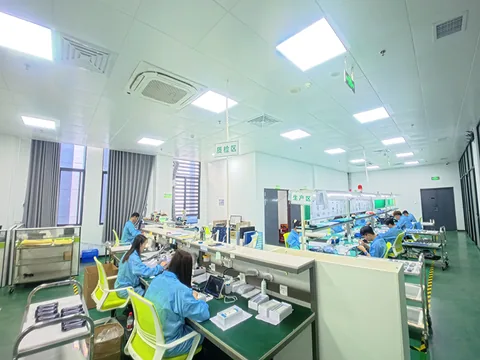
Four working areas inside one building: material in, complete systems out, with no doubling back.
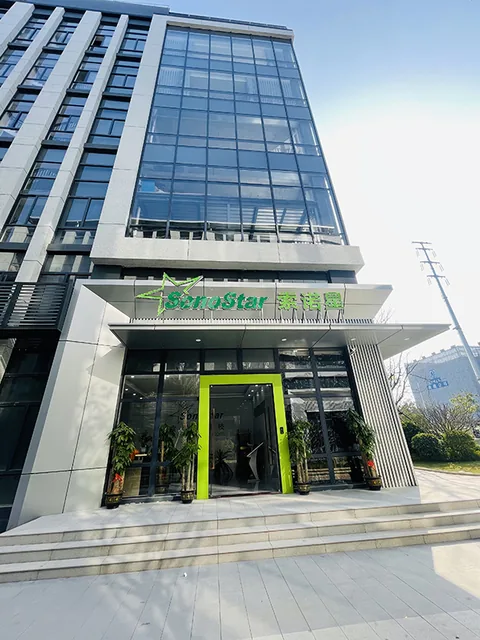
A whole building, offices and production at one address
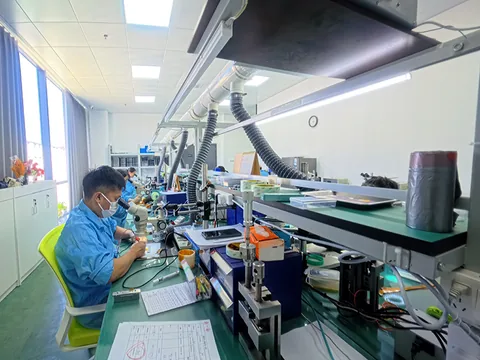
The probes are made in our own welding room
An ultrasound probe is one of the hardest components in this industry to subcontract: the array layout of the piezoelectric elements, the wire-harness soldering and the acoustic matching layers — a deviation in any one of them shows up directly in the image. So probes are not outsourced: from element assembly to harness soldering, the work is done inside our own plant, and every probe is then put on a system and its image measured one by one.
Making the probe and then building the system in the same building has a very practical benefit: if something goes wrong between probe and host, there are no two suppliers to bounce it between.
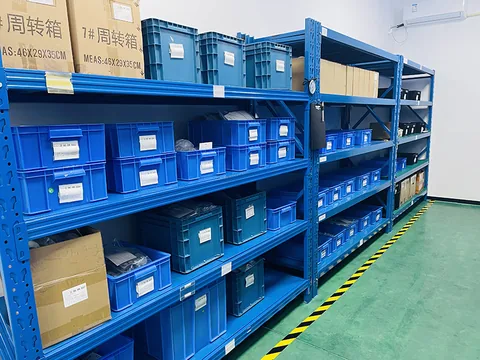
Incoming goods and materials
Electronic components, structural parts and packaging materials are stored in separate areas and labelled by model and batch; material that has not been inspected does not enter production.
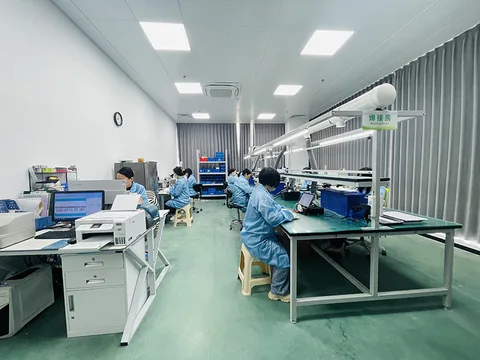
Welding and assembly
Probe welding stations sit next to system assembly stations; work in progress moves to job orders and goes straight from assembly into calibration.
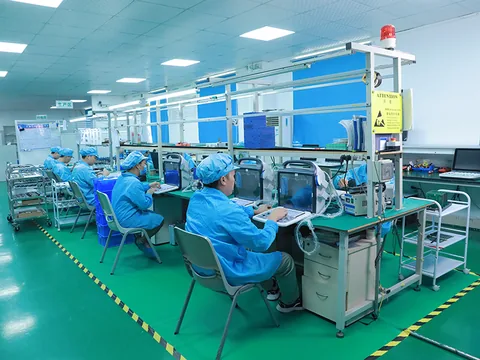
Calibration and burn-in
Systems are powered up and calibrated and then run continuously for burn-in, so that early failures are caught before shipment.
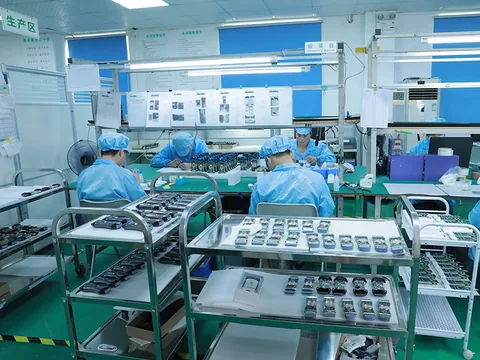
Finished goods and storage
Systems that have passed inspection are packed and put into stock here, stored in areas by model and batch and ready for dispatch.
How one system is built
Five production steps, each one guarding against a specific kind of error.
Incoming inspection
Components, structural parts and cable are inspected on arrival: model, batch and appearance are checked, and anything that fails is returned. This step guards against bad material entering the line and only being discovered once it is a finished system.
Welding and assembly
Element assembly and harness soldering for probes; mainboard and structural assembly for systems. This step guards against cold joints, wrong parts and assembly stress — none of which can be found on the finished product, so they can only be controlled here.
System calibration and burn-in
Parameters are set with the system powered up, image and measurements are checked, and then the unit runs continuously for burn-in. This step guards against early failures reaching the customer and only failing after a fortnight of use.
Factory inspection
Every item in the product technical requirements attached to the registration is tested, recorded per unit and signed off into the file, and only then is the unit released. This step guards against non-conforming product leaving the factory.
Packing and stocking
Host, probes, accessories and accompanying documents are made up complete for the model, packed for shock protection and put into stock. This step guards against transport damage and shipment of the wrong model.
How we inspect: basis, role, timing, records
Inspection is not a single gate at the end but four lines running from material intake through to system release.
| Inspection basis | The product technical requirements attached to the product registration certificate — one document per certificate, setting out the test items and acceptance criteria |
|---|---|
| Inspection role | Quality inspection is separate from assembly, and the inspector signs for the result |
| Inspection points | Three points — material intake, completion of assembly and system release — each inspected once |
| Inspection records | Recorded per unit and filed with the batch, traceable by model and batch |
| Release criteria | Only when every test item passes is the unit packed and stocked; failures are repaired and re-inspected |
Individual test items are carried out as set out in the product technical requirements, with a record kept for every unit; if you need to check the test list for a particular model, ask for it during a factory audit or at the quotation stage.
What we make: from a single probe to a complete system
Grouped by manufacturing capability rather than presented as a catalogue — the catalogue is in the product centre.
| Category | Actually in production | Coverage |
|---|---|---|
| Wireless ultrasound probes | 5 / 6 / 7 / 8 / 9 series | Convex, linear, phased array, endocavity, microconvex, dual-head and three-in-one, with frequency coverage of 2.2–24 MHz; including models with replaceable batteries and models with magnetic navigation |
| Handheld ultrasound systems | The probe is the system, wireless to a phone or tablet | System and probe are produced under the same process, and the combination is image-tested before release |
| Portable colour ultrasound | C8 / C10 / C10B / CTouch-10 / SS-5 / SS-6 / SS-7C / SS-8C / SS-9B | 10–15 inch screens, in both greyscale and colour grades |
| Trolley colour ultrasound | C100T / C200 / C200T / C300 / C5T / C600 / SS-100 / T3 / U1000 | 14–20 inch screens, built-in battery, two probe ports |
| Specialty devices | Ophthalmic SAB-200 / SAB-500 / SAB-600 / SAP-100; bladder BProbe-2 / BProbe-5 | Ophthalmic A/B-scan, corneal pachymetry and wireless bladder volume measurement |
| Therapy and monitoring | U1 / UD30 / E8; SE series ECG; SM series monitors and fetal monitors | Ultrasound therapy and drug delivery, 12-lead ECG, multi-parameter and fetal monitoring |
| Veterinary devices | V6 / V7 / VProbe / VProbe-1 / VProbe-2B / VProbe-4L / VProbe-5Q | Pregnancy and backfat measurement, waterproof models, in handheld and chest-worn forms |
| Accessories | Carts, mobile trolleys, wireless charging pads, probe biopsy guides, ultrasound workstations, video printers and more | 11 items in total, made alongside the host units, with interfaces and structure matched to each model |
Models in production follow the models listed in each category of the product centre; this page shows representative models only, and the table is adjusted as models are added or discontinued.
See all products Handheld ultrasound and wireless probes Probes and accessories
What orders we can take
Three lines, all resting on the same production line and the same inspection.
Complete-system ODM / OEM
Housing, boot screen, packaging and branding to the customer's requirement, with prototypes and volume production on the same line.
Probe customization
Element count, frequency and housing adjusted to specialty requirements (convex, linear, phased array, endocavity), with probes made in our own workshop.
Software and algorithm customization
Specialty measurement packages, multimodal interfaces and auto-measurement, developed on the existing platform.
| Minimum order quantity | From 1 unit — a single standard unit can be ordered, and prototype and single-unit purchases are accepted equally; minimum quantities for private-label and ODM projects are agreed per project |
|---|---|
| Normal lead time | Confirmed against the current production schedule and answered in writing at the quotation stage |
| Ways of working together | Supply under our own brand, regional distribution, or ODM / OEM private labelling |
| Customization details | For process, packages and sampling arrangements see the Custom Development page |
Five things buyers ask most often
Can we visit the plant?
Yes, with advance notice. The address is Building 7, Zhongjiao Zhizao Park, No. 6 Hengchuang Avenue, Zhongxin Town, Zengcheng District, Guangzhou; offices and production are in the same building, so the workshops and the inspection area can be seen in one visit. Please contact us beforehand to agree a time, so that someone can accompany you.
What is the minimum order quantity?
One unit for standard models, and prototype and single-unit purchases are accepted equally. Minimum quantities for private-label and ODM projects are agreed per project; where housing and software changes are involved, a certain volume is normally needed to amortize development and tooling investment.
What is the normal lead time?
Lead times are confirmed against the current production schedule and answered in writing at the quotation stage. Standard models are usually in stock or in a current production batch; customization and private-label projects need sampling and validation time on top.
Can you put our brand on the product?
Yes. Complete-system ODM / OEM covers replacement of the brand on the housing, boot screen, packaging and instructions; probes and software can also be customized per project. How the work is divided and how intellectual property is owned is explained on the Custom Development page.
How is quality assured?
Four levels. First, licensed production: medical device production licence 粤食药监械生产许20132454号, scope Class II, 06 medical imaging equipment. Second, 4 Class II medical device registration certificates, with products manufactured and inspected to the product technical requirements attached to them. Third, ISO 9001 quality management system certification (certificate 91226Q00001R000, valid until 2029-01-11). Fourth, factory inspection of every unit with the record filed, so that it can be traced.
What else you may want to check, and where
| What you want to see | Which page | What is there |
|---|---|---|
| The company's business registration, licence numbers and validity periods | Company information | Credit code, registered address and 11 licences numbered one by one |
| Original certificates and patents | Certificates | Registration certificates, production licence, ISO certificate and patent certificates available for download |
| Private labelling, and how probes and software can be changed | Custom Development | Three customization lines, process, packages and minimum quantities |
| Specific models and specifications | Products | 102 models across 10 categories |
| Selection comparisons and downloads | Selection Guide · Downloads | Selection comparison tables, manuals and software |
| Discussing an order or booking a plant visit | Contact us | Address, phone, email and who handles what |
Visits and samples: Building 7, Zhongjiao Zhizao Park, No. 6 Hengchuang Avenue, Zhongxin Town, Zengcheng District, Guangzhou (offices and production at the same address); Phone: +86 13434822215 (Mr. Zhong, same number on WhatsApp); Email: sonostar168@163.com; Hours: Mon-Fri 9:00-22:00, Sat 9:00-18:00(Beijing Time, GMT+8)
Would you like a look at the workshop first?
Tell us the model and the intended use, and we will arrange someone to accompany you around the plant, from the probe welding stations through to the system inspection area.
Book a plant visit